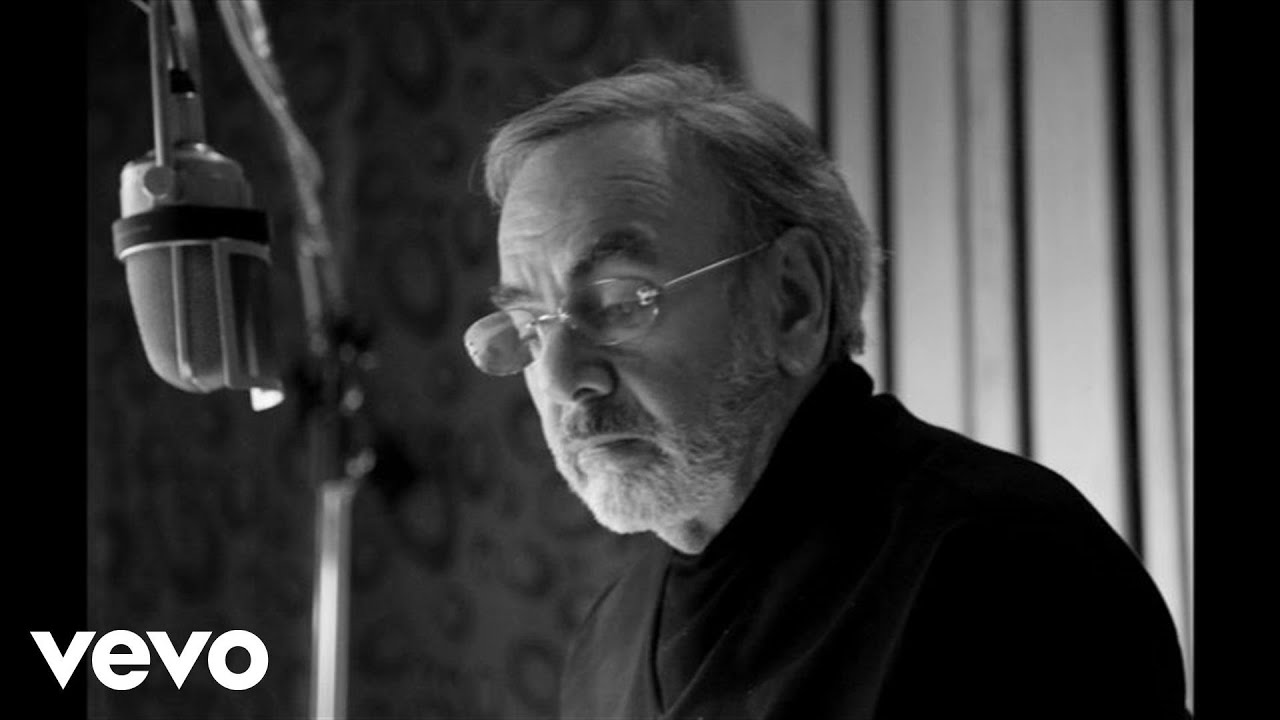
On a polished 1981 album built for big melodies, Neil Diamond let a quieter wanderer step forward with a song that feels smaller, lonelier, and more revealing than its place in the track list suggests.
Neil Diamond recorded The Drifter as an album track on On the Way to the Sky, his 1981 studio album released in the wake of the enormous public attention surrounding The Jazz Singer soundtrack. That context matters. Diamond was not arriving in 1981 as a new name trying to prove himself; he was already one of American popular music’s most recognizable voices, a songwriter-performer whose work could fill arenas and still sound like a private confession over a late-night radio. Yet within the smooth, carefully framed atmosphere of On the Way to the Sky, The Drifter carries a different kind of pull. It is not the song most casual listeners immediately reach for from the album, and it was never destined to eclipse the more visible radio moments around it. That is part of why it deserves another listen.
On the Way to the Sky followed a remarkable period in Diamond’s career. The Jazz Singer had given him a new kind of mainstream exposure, with songs such as Love on the Rocks, Hello Again, and America becoming deeply associated with his early-1980s image: dramatic, polished, romantic, and built for large emotional spaces. By comparison, The Drifter feels less like a public declaration and more like a figure glimpsed at the edge of the room. It belongs to the Neil Diamond who often wrote about motion, exile, hunger, and belonging—the songwriter who understood that success does not always settle the spirit.
The title itself is almost too simple: The Drifter. In Diamond’s hands, that word carries more than a travel story. A drifter is not merely someone who moves from place to place. He is someone who cannot quite rest inside a life that looks fixed from the outside. Diamond had returned to this emotional territory throughout his career, sometimes through the language of the road, sometimes through the language of love, and sometimes through characters who seem to be searching for a home they might not recognize even if they found it. On this 1981 album track, that familiar restlessness is softened by the adult-pop production of the era, but it is not erased. If anything, the contrast makes the ache more interesting.
Musically, The Drifter sits in the space where Diamond could be both theatrical and plainspoken. His voice has the grain of experience in it, but he does not need to push too hard. He had already proven that he could deliver the sweeping chorus, the arena-size emotional lift, the line that seemed to rise above the crowd. Here, the appeal is more inward. The song invites the listener to hear the character not as a mythic wanderer, but as a man whose movement may be less adventurous than necessary. There is a kind of loneliness in that distinction. The road can look romantic from a distance, but from inside the song it feels like a habit, maybe even a defense.
That is one reason overlooked album tracks can sometimes tell us more than the famous singles. Singles often carry the public face of an era: the cleanest hook, the most immediate chorus, the lyric that radio can hold in the palm of its hand. Album cuts are freer to be unsettled. They do not always need to announce themselves. The Drifter benefits from that freedom. It does not have to become the whole story of On the Way to the Sky; it simply opens a side door into Diamond’s recurring fascination with people who are caught between arrival and escape.
There is also an interesting tension between the album’s title and this track’s emotional landscape. On the Way to the Sky suggests ascent, optimism, upward movement. It has the ring of ambition and possibility. The Drifter, by contrast, moves horizontally. It wanders. It follows roads rather than stars. Heard within the album, the song gives the record a human shadow. It reminds us that the journey upward is rarely clean. Some people climb; some circle; some keep moving because standing still would force them to face the silence.
By 1981, Diamond’s songwriting persona had become familiar enough that some listeners may have taken its emotional vocabulary for granted. The strong baritone, the romantic urgency, the broad melodic gestures—these were recognizable parts of the Neil Diamond experience. But The Drifter shows how much feeling could still live in a less celebrated corner of his catalog. It does not need to be rescued by exaggeration. It only needs to be heard with patience, as a track from an artist who understood that motion can be both freedom and confession.
For fans who know Diamond mainly through the songs that became communal sing-alongs, The Drifter offers a quieter kind of reward. It is not about the crowd singing back. It is about the solitary figure still walking after the lights have dimmed, still carrying a private weather no applause can change. That may be why the song lingers. It is not one of the biggest monuments in Neil Diamond’s catalog, but it has the shape of a doorway—small, open, and unexpectedly deep.
