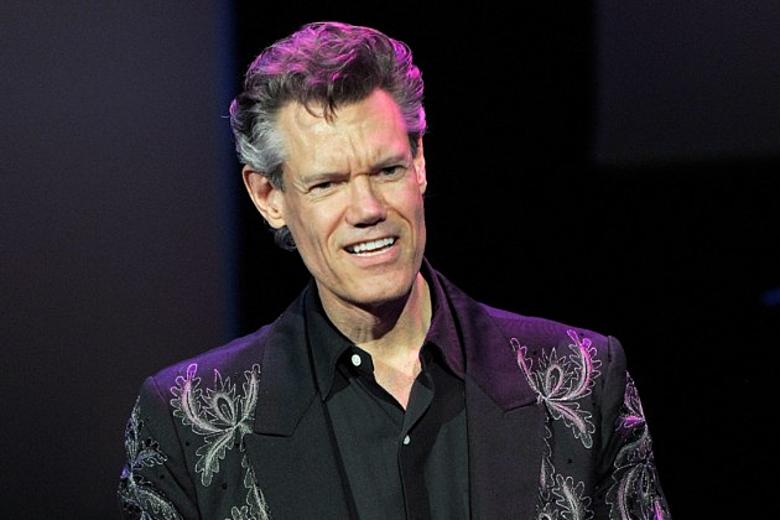
In the middle of a changing country decade, Randy Travis turned a quiet phrase into a No. 1 reminder of how much power a restrained voice can hold.
Randy Travis released Whisper My Name in 1994 as the second single from This Is Me, an album that placed him squarely inside a new chapter of country music without asking him to abandon the gravity that had made his voice matter in the first place. Written by Trey Bruce and recorded during Travis’s long Warner Bros. Nashville era with producer Kyle Lehning, the single climbed to No. 1 on the Billboard country singles chart. That chart success is part of the story, but it does not fully explain why the song has remained so closely tied to this moment in his career. The real force of the record lies in how quietly it announces itself.
By 1994, the country landscape around Travis had changed. The neotraditional surge he helped bring into the mainstream in the mid-1980s had opened doors for a broader, brighter, arena-sized version of country stardom. New names were crowding radio, production styles were becoming sleeker, and the genre was learning how to balance rural memory with pop-scale ambition. Travis, who had once sounded like the corrective to Nashville gloss, now had to prove something subtler: that a voice rooted in stillness could still command attention when the room had grown louder.
This Is Me answered that challenge not by chasing fashion, but by sharpening the familiar elements of his artistry. Whisper My Name fits that era beautifully. It is not the rowdy Travis of honky-tonk bite, nor the conversational warmth of Forever and Ever, Amen. It is something more inward, more polished, and more carefully lifted. The arrangement gives him space. The song moves with the patience of a confession, building its emotional case through images of sound, silence, awe, and transformation. Instead of overwhelming the listener, it lets one simple act carry almost sacred weight: someone speaks his name softly, and the world changes shape.
That is where Travis’s performance becomes essential. Many singers could have turned the lyric into open drama, pressing hard on its devotional language and big emotional sweep. Travis does the opposite. His baritone does not rush toward intensity; it settles into it. He sings as if the song’s wonder is not theatrical but discovered, something that surprises even the person feeling it. His phrasing gives the record its dignity. Every line seems to arrive after a breath of thought, and every rise in the melody feels earned rather than displayed.
In that sense, Whisper My Name functions as a signature song of the This Is Me period. It may not be the first title casual listeners name when they think of Randy Travis, but it captures a crucial kind of maturity in his catalog. A signature song is not always the biggest anthem or the one tied to the most obvious memory. Sometimes it is the recording that reveals an artist’s shape at a particular season of life. Here, Travis sounds less like a new traditionalist making a point and more like a seasoned singer trusting the quiet center of his gift.
The song’s No. 1 success also says something about country radio at that moment. For all the changes of the early 1990s, there was still room for a ballad that asked listeners to lean in. Whisper My Name did not need speed, swagger, or novelty to reach people. Its appeal came from recognition: the feeling that love can turn ordinary language into something enormous, that a name spoken by the right person can become a private kind of music. Travis had always understood the emotional force of plain words, and this single gave him a lyric built almost entirely on that principle.
What makes the recording linger now is not simply nostalgia for 1994, though the song certainly carries the atmosphere of that radio era. It lingers because it catches Randy Travis at a crossroads and shows him choosing control over spectacle. The voice is deep, but not heavy-handed. The production is smooth, but not faceless. The sentiment is large, but it is delivered with restraint. In a decade that often rewarded expansion, Whisper My Name found its strength in reduction: one voice, one phrase, one emotional turn that made the familiar feel newly alive.
He had already given country music several songs that felt carved into the public memory. With Whisper My Name, he offered something quieter but no less revealing: a mid-career reminder that his greatest instrument was not merely the depth of his voice, but the judgment behind it. He knew when to hold back. He knew when to let a line breathe. And in this 1994 chart-topper, he proved that a whisper, sung with conviction, could still rise above the noise.
