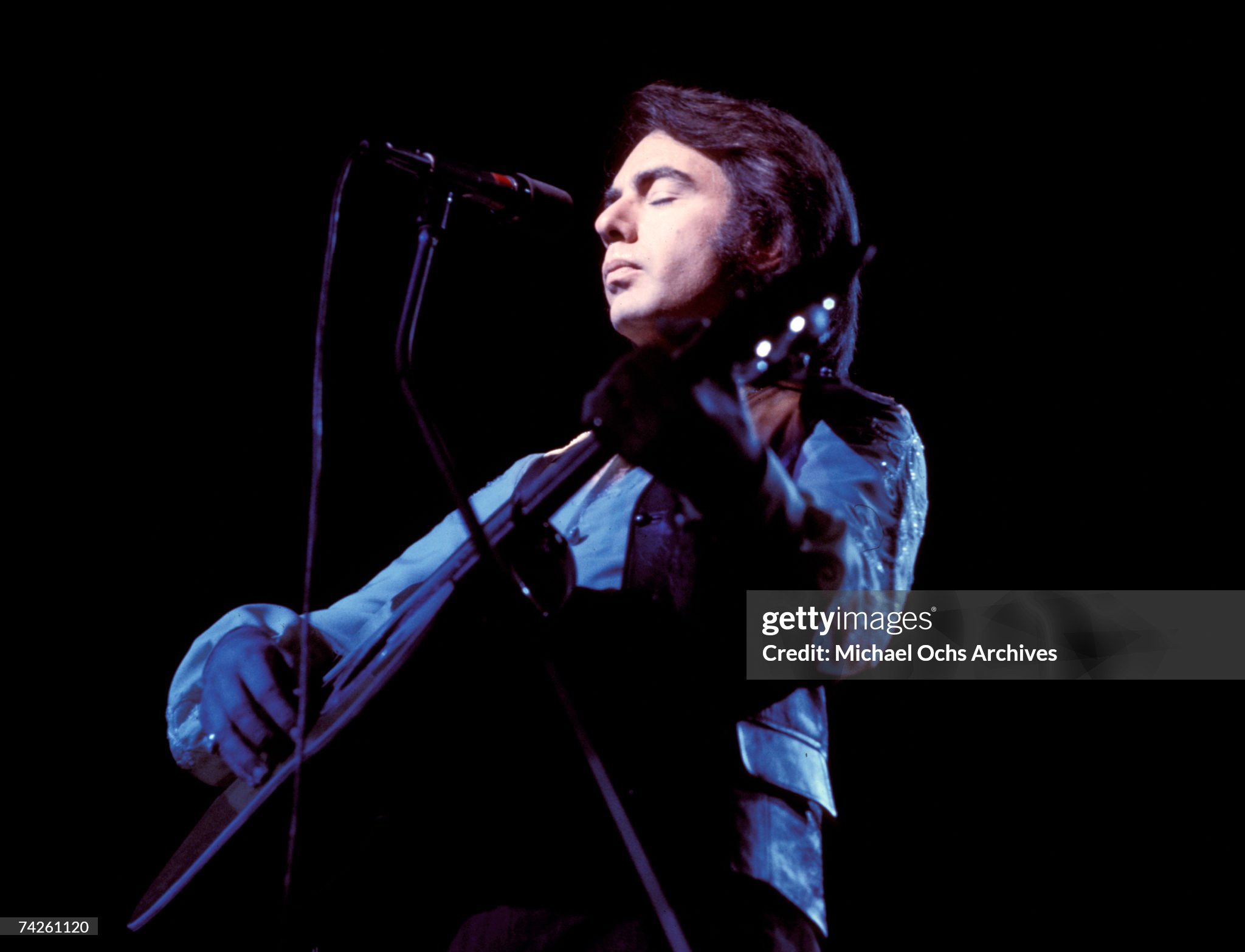
On a 1977 album filled with grand romantic shadows, Neil Diamond’s Let Me Take You In My Arms Again makes the biggest gesture sound like a quiet plea.
Neil Diamond released Let Me Take You In My Arms Again as part of his 1977 Columbia album I’m Glad You’re Here With Me Tonight, a record that arrived during one of the most revealing turns in his career. The album is often remembered because it also carried You Don’t Bring Me Flowers in its original solo form, before the later duet with Barbra Streisand became a major cultural event in 1978. But tucked inside that same album world, this Diamond-written ballad offers something less famous and, in its own way, more intimate: the sound of a showman lowering the scale of his drama until it becomes one person asking another to come back close.
By 1977, Diamond was no longer merely the Brill Building craftsman who had written sharp, radio-ready songs, nor simply the performer whose voice had become part of American pop memory through records like Sweet Caroline and Song Sung Blue. He had moved into a more expansive adult-pop space, where orchestration, theatrical phrasing, and emotional directness could live side by side. I’m Glad You’re Here With Me Tonight, made during his Columbia years and produced by Bob Gaudio, belongs to that polished late-70s moment when the borders between pop, cabaret, soft rock, and romantic confession often blurred.
That context matters because Let Me Take You In My Arms Again does not operate like a casual album filler. It sits inside the emotional architecture of the record, close in spirit to the album title itself. I’m Glad You’re Here With Me Tonight sounds like a sentence spoken after absence, after uncertainty, after a room has finally stopped feeling empty. The song takes that same atmosphere and gives it a more direct shape. Its title is not mysterious. It does not hide behind metaphor. It asks for contact, forgiveness, and the brief mercy of being allowed to hold what may already have been slipping away.
Diamond’s gift on songs like this was not restraint in the modern minimalist sense. He was never afraid of a broad chorus or a sweeping arrangement. What makes the performance affecting is the tension between size and vulnerability. His voice can rise with the weight of a full romantic declaration, but underneath that rise there is a feeling of uncertainty. He sounds commanding and exposed at the same time, as if the very act of singing loudly is a way of admitting how much is at stake. That contradiction was central to his 1970s appeal. He could fill arenas, but he often wrote from the point of view of someone alone at the edge of a conversation.
The arrangement carries the marks of its era without feeling disposable. The studio polish, the carefully shaped dynamics, the sense of emotional lift built into the song’s movement all place it unmistakably in the late 1970s. Yet the heart of the record is simpler than its setting. It is built around the old human desire to reverse a moment that has gone wrong. The singer is not making an argument in legal terms. He is not explaining a relationship in detail. He is asking for the body to remember what the heart is afraid it has lost. In that sense, the title line becomes almost ceremonial: let me take you in my arms again, let me return to the place where words may not be enough.
Heard beside You Don’t Bring Me Flowers, the song becomes even more interesting. The latter would soon be transformed in the public imagination through the famous Diamond-Streisand duet, turning domestic distance into a shared theatrical exchange. Let Me Take You In My Arms Again remains more solitary. There is no second voice to answer him, no duet partner to turn the ache into dialogue. That absence gives the track its own quiet force. It feels like one side of a conversation suspended in the air, waiting to find out whether the silence on the other side is refusal, hesitation, or the beginning of forgiveness.
As an album-era piece, it also reminds listeners how much of Diamond’s catalog lives beyond the handful of songs that dominate radio memory. The deeper tracks can reveal the emotional climate of a period more honestly than the famous hits sometimes do. On I’m Glad You’re Here With Me Tonight, Diamond was working within a romantic language that was lush, sincere, and unguarded by modern irony. That openness can feel almost startling now. He sings as if the risk of sounding too earnest is smaller than the risk of leaving something unsaid.
Let Me Take You In My Arms Again may not be the first title people name when they talk about Neil Diamond’s 1977 album, but it belongs to the record’s central mood. It catches him in a place between public grandeur and private longing, between the confident entertainer and the man inside the song who knows that love is not secured by volume alone. Its beauty is not that it solves the ache it describes. Its beauty is that it stands inside that ache with open arms, still believing that a return is possible.
