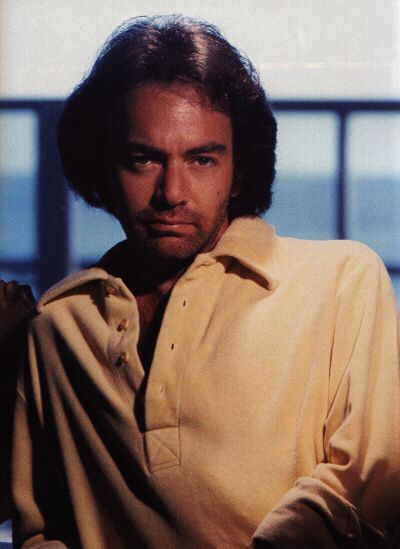
In Primitive, Neil Diamond met the glossy pressure of 1984 without surrendering the restless pulse that had always driven his songs.
Released in 1984, Primitive was the title track from Neil Diamond’s sixteenth studio album, a record that placed one of American pop’s most recognizable singer-songwriters directly inside the sleek, high-sheen atmosphere of the 1980s. By that point, Diamond was far beyond the stage of proving himself. He had already traveled from the disciplined craft of New York songwriting rooms to radio dominance, arena singalongs, film soundtrack visibility, and the kind of concert persona that could turn a large room into something strangely personal. Yet Primitive matters because it catches him in a different kind of moment: not at the beginning of a rise, and not simply repeating an old formula, but adjusting his dramatic voice to a decade that wanted harder surfaces, brighter production, and cleaner edges.
The title alone creates a useful tension. The word Primitive suggests instinct, appetite, something older than polish. It points toward impulse rather than sophistication, toward the body before the explanation. But the song arrived during an era when mainstream pop often sounded anything but primitive. The mid-1980s favored tight studio architecture, crisp percussion, synthesizer color, and arrangements that could carry emotional directness through a distinctly modern shell. That contrast gives the track its particular charge. Diamond is singing into a world of refinement, but the word at the center of the song keeps pulling the listener back toward something less controlled.
That contradiction suits Neil Diamond. His best-known work often lives between opposites: showmanship and solitude, grandeur and vulnerability, public gesture and private ache. He could write a melody broad enough for thousands of people to sing together, then bend a phrase as if he were speaking to only one person. In Primitive, the 80s framing does not erase that quality. If anything, it throws it into sharper relief. The production belongs to its time, but the emotional engine is recognizably his: direct, physical, insistent, more interested in the surge of feeling than in cool detachment.
The song also belongs to an important stretch of Diamond’s career. After the major visibility of The Jazz Singer soundtrack at the start of the decade and the adult-pop success that continued around him, he was an established figure working in a changing marketplace. Pop radio was moving quickly. Younger acts were turning image, video, electronics, and rhythm into a new common language. For an artist associated with the warmth of the singer-songwriter era, the challenge was not simply to sound current. The challenge was to enter the new sound without losing the grain of the voice, the dramatic phrasing, and the sense of emotional declaration that listeners associated with his name.
He did not have to become someone else to do it. That is the quiet fascination of Primitive. The track does not ask us to forget the man who wrote and sang songs of longing, arrival, faith, loneliness, and desire across the previous two decades. Instead, it lets that man step into a brighter room. The edges may be cleaner, the studio palette more contemporary, but the performance still depends on Diamond’s ability to make a phrase feel like a personal vow. He was never merely a smooth singer; there was always a gravelly push in his delivery, a sense that the voice was climbing toward something it needed to say.
As a title track, Primitive also helps frame the album’s larger identity. A title song often acts like a sign over the door, telling the listener what emotional territory they are entering. Here, the word does not suggest simplicity in the musical sense. It suggests the persistence of basic human drives underneath changing fashions. In 1984, with pop music surrounded by new studio tools and visual language, Diamond’s choice of that word feels almost like a reminder: beneath the polish, beneath the career machinery, beneath the changing decade, songs still work because people recognize hunger, attraction, fear, confidence, and need.
That may be why the track continues to invite a more careful listen than a casual glance at its era might suggest. It is easy to file many 1980s recordings under their production style, as if the sound of the decade were the whole story. But Primitive is more interesting when heard as a meeting point. It is not simply Neil Diamond dressed in 80s clothing, nor is it a rejection of the decade around him. It is a negotiation between identity and atmosphere. The familiar force of his voice moves through a more polished framework, and the result carries the tension of an artist both rooted and alert.
There is a human truth in that. By the time an artist reaches a sixteenth studio album, the question is rarely whether he can make another record. The deeper question is how much of himself can remain intact while the world changes its rhythm around him. Neil Diamond had built his career on songs that turned feeling into shape, songs that could be theatrical without being hollow. With Primitive, he allowed the 1984 soundscape to press against him, but not to swallow him. The track stands as a snapshot of adaptation: a seasoned performer leaning into a new decade while still sounding driven by something older than fashion.
Heard now, Primitive does not need to be treated as a period piece only. Its appeal lies in the friction between surface and impulse. The song carries the shine of its moment, but at the center is that unmistakable Diamond urgency, the sense of a man turning a simple word into a declaration of appetite and motion. It reminds us that even in the most carefully produced pop eras, the strongest songs often come down to something elemental: a voice, a pulse, and the stubborn need to be felt.
