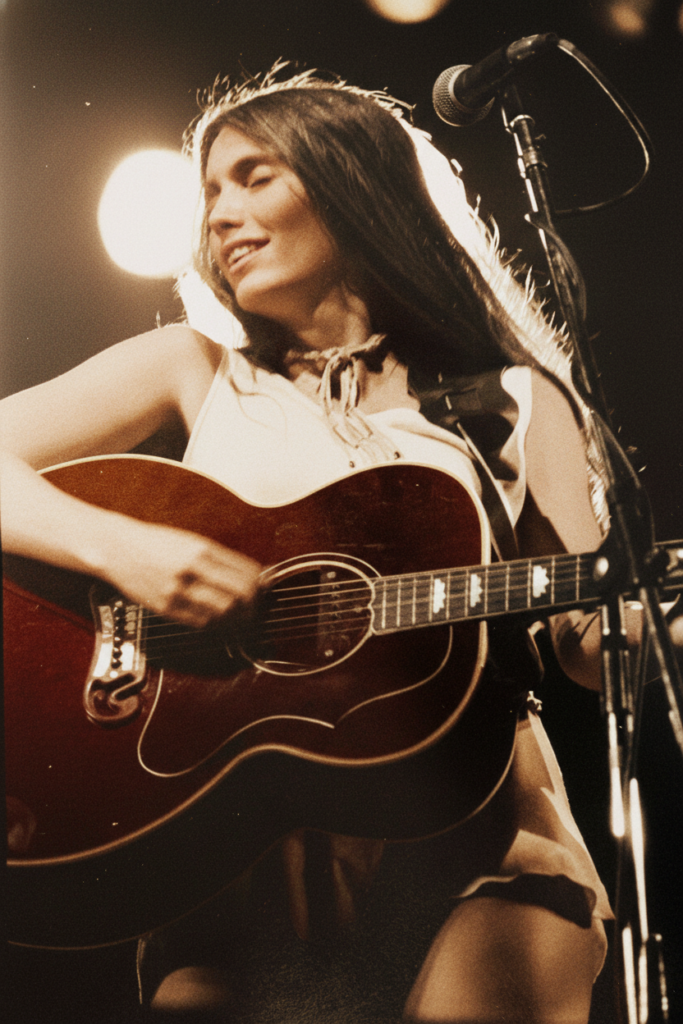
On Cowgirl’s Prayer, Emmylou Harris turns You Don’t Know Me into a lesson in restraint, where longing survives because it is never fully spoken.
Released in 1993 on the album Cowgirl’s Prayer, Emmylou Harris’s version of You Don’t Know Me is not simply a respectful cover of an Eddy Arnold classic. It is a graceful reconsideration of a song that had already passed through several generations of American music, carrying with it the manners of country balladry, the ache of pop confession, and the quiet sophistication of a lyric built around everything left unsaid. Harris does not try to overpower that history. She steps into it carefully, as if the song were a room where the air still held the voices of those who came before her.
You Don’t Know Me is credited to Cindy Walker and Eddy Arnold, with Walker shaping the lyric from Arnold’s title and emotional idea in the 1950s. Arnold’s own recording helped place the song firmly inside the country songbook, while later interpretations, especially Ray Charles’s celebrated 1962 reading, broadened its reach far beyond any single genre. By the time Harris recorded it for Cowgirl’s Prayer, the song was already familiar enough to feel almost inevitable. Its opening situation is simple: two people meet, one offers a hand, polite words are exchanged, and beneath that ordinary greeting lies a love that has never been confessed. Yet the song’s power comes from its discipline. It never begs too loudly. It never collapses into melodrama. It hurts because it behaves.
That quality makes Harris a natural interpreter. Across her career, she has often found her deepest authority not in force, but in attention: the way she lets a phrase hover, the way she honors the shape of a melody, the way she can make a familiar line feel newly vulnerable without bending it out of recognition. On Cowgirl’s Prayer, her performance arrives during a revealing moment in her artistic path. The album was released two years before Wrecking Ball, the 1995 record that would dramatically reshape her sound with Daniel Lanois. Here, Harris is still moving within the country, folk, and acoustic traditions that had long nourished her music, but there is already a feeling of inward turning, of an artist listening closely to what silence can do.
Her 1993 interpretation of You Don’t Know Me understands that the song is not about a grand declaration. It is about the inability to make one. The narrator is standing close to the person who matters most, yet remains emotionally invisible. In lesser hands, that situation can become a showcase for vocal suffering. Harris chooses something more difficult. She keeps the feeling contained. Her voice does not push the lyric toward spectacle; it lets the words sit plainly in the mouth, where their restraint becomes the point. When she sings as someone who is known socially but not truly seen, the song becomes less a performance of sorrow than a portrait of composure under pressure.
Part of the beauty of Harris’s version lies in how little it tries to modernize the song’s emotional vocabulary. The lyric belongs to a world of formal gestures: a hand, a greeting, a smile, a dance of politeness that conceals a deeper intimacy. Rather than treating those gestures as old-fashioned, Harris lets them regain their dignity. She seems to understand that many of the most painful moments in life do not arrive with dramatic language. They arrive in small exchanges, in rooms where one person says too little because saying more would change everything. Her reading keeps the song balanced between memory and present tense, as if the unspoken confession has been rehearsed for years but still cannot cross the threshold.
Musically, her approach feels spacious and carefully measured. The arrangement does not need to crowd the melody because the melody already carries the story. Harris’s gift is to let the song breathe without making it feel empty. The performance has the poise of classic country, but it also carries the reflective softness of her own mature style. The listener can hear why You Don’t Know Me survived so many versions: it offers each singer a different kind of loneliness. For Arnold, it belonged to the smooth ache of country-pop elegance. For Ray Charles, it became a bridge between country sorrow and soul phrasing. For Harris, on Cowgirl’s Prayer, it becomes something quieter still: a confession folded neatly and kept close to the heart.
What makes this cover especially affecting is the way Harris refuses to claim the song too aggressively. She does not sing as if she has discovered a secret meaning that no one else noticed. Instead, she trusts the old meaning and gives it room to settle in a different light. That humility is part of her artistry. Harris has always been a great custodian of songs, not because she preserves them behind glass, but because she allows them to keep living in her voice. Her You Don’t Know Me respects the elegance of the original while revealing how elastic the song’s emotional center can be. It can belong to another decade, another singer, another arrangement, and still feel immediate when handled with care.
In the larger shape of Cowgirl’s Prayer, the track also speaks to Harris’s enduring relationship with country music’s older language of longing. The album is not merely a collection of songs; it is a portrait of an artist who understood tradition as conversation. By placing You Don’t Know Me inside that 1993 setting, Harris lets the past answer the present. The song does not sound like a museum piece. It sounds like something that has been waiting patiently for another voice to reveal one more shade of its meaning.
That is why this graceful reinterpretation continues to matter. It reminds us that a cover version does not have to compete with memory to be valuable. Sometimes the truest act is not reinvention, but listening. Harris listens to the song’s manners, its hesitation, its wounded civility, and its refusal to say too much. In doing so, she turns You Don’t Know Me into a quiet study of emotional distance: two people close enough to touch, separated by the words that never arrive. The performance lingers because it does not force the door open. It simply stands there, hand extended, letting the silence tell the rest.
