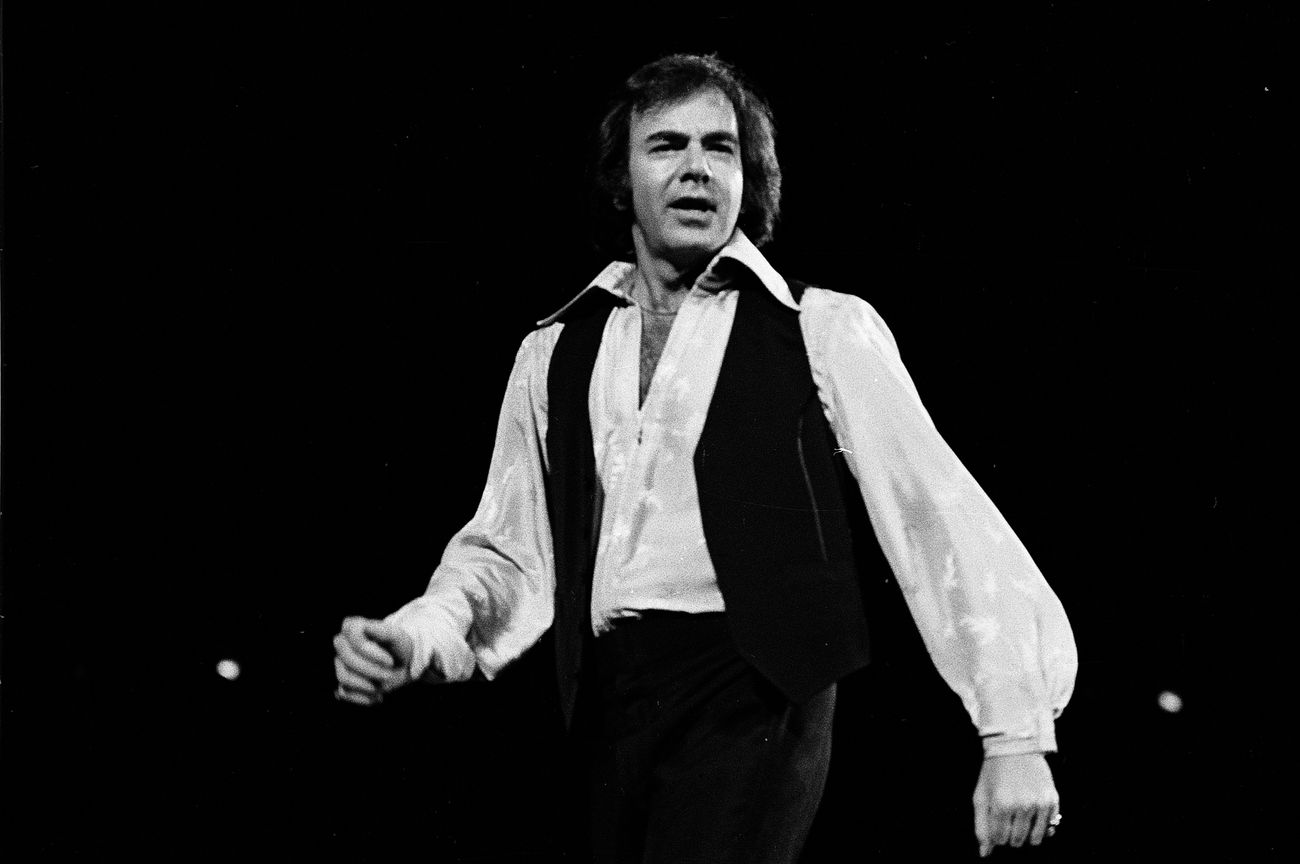
Before the familiar hits arrive, “Lordy” throws open the door to Neil Diamond’s 1970 Troubadour night with a restless, gospel-tinged surge.
Neil Diamond placed “Lordy” at the very front of Gold: Recorded Live at the Troubadour, his 1970 live album captured in the intimate Los Angeles club that helped define the singer-songwriter era. That placement matters. Before the audience hears the better-known names in his catalog, before memory settles into “Sweet Caroline”, “Holly Holy”, or “Solitary Man”, Diamond begins with a song that sounds less like a polite introduction and more like a door being kicked open from the inside.
The Troubadour was not an arena, and in 1970 Diamond was not yet the vast concert figure he would become after later live milestones such as Hot August Night. On Gold, the room feels close enough to touch. You can sense the scale before the first notes even settle: not small in ambition, but compact in pressure. The applause, the band’s attack, the closeness of the crowd, and Diamond’s urgent delivery all create the feeling of a performer still proving something in real time. “Lordy” is the perfect spark for that setting because it does not ask to be admired from a distance. It moves forward, full of nerve.
Part of the fascination of this live opener is how it catches Diamond in transition. He had already written and recorded major pop successes, and his voice was known from radio as direct, dramatic, and unmistakable. Yet the Gold performance shows another dimension: the working bandleader, the club performer, the man who could turn a familiar phrase into a physical event onstage. In a studio, a Neil Diamond song could be shaped by arrangement and polish. At the Troubadour, “Lordy” becomes sweat, rhythm, timing, and command.
The song carries traces of gospel fervor, rock movement, and the earthy theatricality that would become one of Diamond’s strongest live signatures. It is not gospel in a church sense, and it is not rock in the loose, reckless way some bands played it then. Instead, it sits in that particular Diamond space where spiritual language, pop urgency, and stagecraft meet. He knew how to make a chorus feel like a gathering. He knew how to put weight behind a simple word. In “Lordy”, repetition does not feel lazy; it feels like insistence, the sound of a singer raising the temperature of the room by degrees.
What makes the performance especially striking is that it arrives before the safety of recognition. Many live albums lead with the obvious hit, the song everyone already knows, the dependable handshake between artist and crowd. Gold: Recorded Live at the Troubadour begins with momentum instead. It trusts the room. It trusts the band. It trusts Diamond’s ability to establish authority before nostalgia has a chance to do the work for him. That is why the opening track still feels revealing: it shows how his live reputation was being built not only on the strength of famous songs, but on his ability to make a stage feel occupied from the first breath.
There is also something bracing about hearing Diamond in this club-sized frame. Later images of him often involve larger venues, dramatic lighting, and audiences singing back lines that had become part of American pop memory. The Troubadour recording is different. It preserves the earlier tension of proximity. The crowd is near, the band is lean, and the performance has the grain of a night that could still go anywhere. “Lordy” benefits from that uncertainty. It does not sound preserved behind glass. It sounds active, as if the musicians are still negotiating the energy of the room while the tape is running.
As an album opener, it also frames the rest of Gold with a particular emotional argument. This is not merely Neil Diamond presenting a set of songs. It is Neil Diamond declaring a kind of live identity. The hits that follow may carry more public memory, but “Lordy” explains the engine underneath them: the drive, the pulse, the almost revival-like need to reach people directly. It turns the album from a document into an entrance.
More than half a century later, the performance still has that first-track electricity. It reminds us that a live album can capture not only songs, but thresholds: the point where a songwriter becomes a performer in full command of the moment, where a club becomes a proving ground, where a career’s public image is still being forged in the heat of a room. On “Lordy”, the young Neil Diamond of 1970 does not ease listeners into Gold. He arrives already moving, already calling, already making the Troubadour feel larger than its walls.
