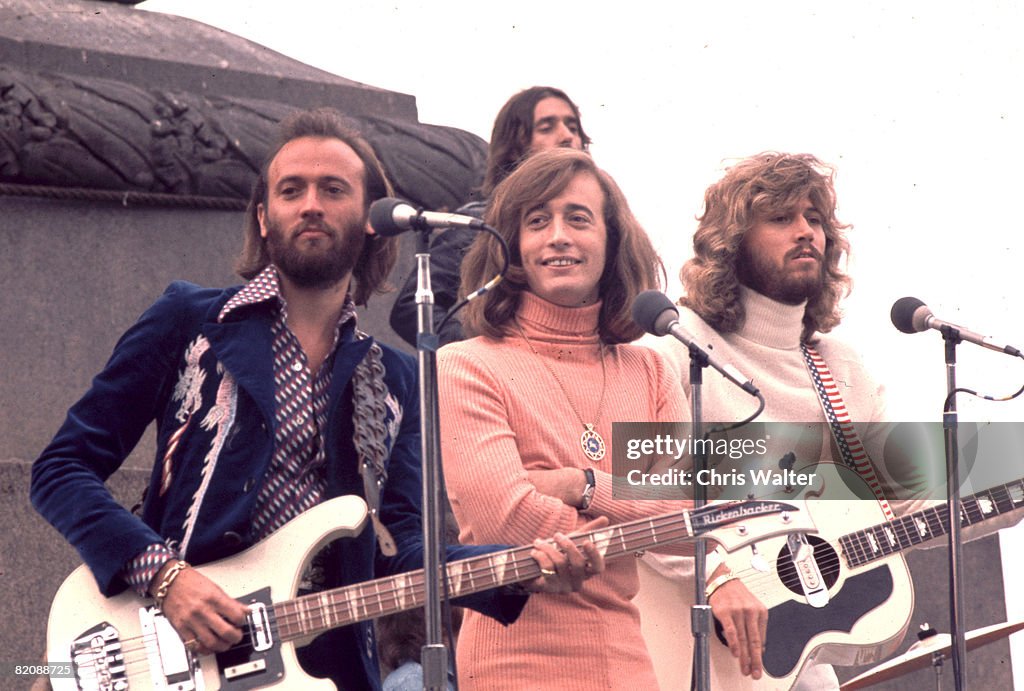
Some songs announce themselves at once. Whisper Whisper by the Bee Gees does something more intriguing, opening like a private thought and slowly widening into one of the most unusual corners of Odessa.
On the Bee Gees’ 1969 double album Odessa, Whisper Whisper can feel like a small mystery tucked inside a large, ambitious record. Odessa arrived at a moment when the group was stretching beyond the concise melancholy and bright melodic craft that had already made them distinctive. It was ornate, theatrical, sometimes pastoral, sometimes baroque, and often willing to let a song change shape while it was still in progress. In that setting, Whisper Whisper stands out as a deep cut that rewards close listening, not because it shouts for attention, but because it keeps revealing new contours the longer it plays.
That is part of what makes it so easy to overlook and so hard to forget once it finds its way in. The title suggests secrecy, restraint, something nearly hidden. Yet the record does not remain hushed. It moves through sections, moods, and textures with a restless intelligence that feels larger than its modest reputation. This is progressive pop in a very late-1960s sense: not the grand, technical display that the word “progressive” would soon bring to mind, but a more melodic, studio-shaped kind of daring, where a song can pivot emotionally without losing its center.
The Bee Gees were especially gifted at that balance. Barry, Robin, and Maurice Gibb understood how to make intricacy feel natural. Even when the arrangement became elaborate, the emotional thread remained clear. In Whisper Whisper, that gift is everywhere. The track begins with a kind of controlled intimacy, then gradually expands, as if the song is discovering it cannot stay inside its own first mood. The shifts do not feel decorative. They feel like the logic of feeling itself: private thought turning into pressure, hesitation turning into motion, softness sharpening into something more urgent.
That sense of unfolding is central to the song’s power. Many album tracks from this period are remembered mainly as sketches toward larger ideas, but Whisper Whisper sounds complete in its own unusual form. It carries the elegance associated with the Bee Gees’ late-1960s work, yet it also has a slightly unsettled edge, as though the song is always leaning toward another room just beyond the one we are in. The result is not a simple verse-chorus comfort. It is a miniature suite, compact but adventurous, shaped by transitions and tonal contrasts rather than easy repetition.
Placed within Odessa, the track also says something important about the album itself. This was not merely a collection of polished songs; it was a world of shifting interiors, old-world imagery, chamber-pop flourishes, and emotional weather that could change in a bar or two. Odessa has long inspired divided reactions precisely because of that scale and ambition. Some hear excess; others hear imagination set free. Whisper Whisper makes the best case for the second view. It shows how the album’s expansiveness could produce songs that were not just ornate, but dramatically alive.
There is also a fascinating tension in hearing a group so often remembered for later eras through this earlier lens. Before the disco years, before the polished global hits that would rewrite their public identity, the Bee Gees were building records full of chamber-pop detail, odd structures, and harmonically rich storytelling. A song like Whisper Whisper reminds us that their history cannot be reduced to one chapter. Their catalog contains secret passageways, and this is one of them.
What lingers most is the emotional architecture of the track. It does not ask to be admired from a distance. It pulls the listener inward, then rearranges the room. The multi-part construction gives the song a sense of motion without sacrificing melody, and that matters. Too many so-called ambitious songs from the era can feel like exercises in form. Whisper Whisper remains musical first. The craftsmanship is there, but so is atmosphere, so is tension, so is that unmistakable Bee Gees instinct for making fragility and sophistication live in the same frame.
Perhaps that is why it feels so contemporary in spirit, even while remaining unmistakably of 1969. It trusts the listener to stay with it. It does not flatten itself into an obvious single. It lets beauty arrive in pieces. In a catalog filled with famous titles, Whisper Whisper survives as one of those songs that deepens the story rather than dominating it. It tells us that the Bee Gees were not only writers of hits, but architects of mood, shape, and surprise.
And that may be the deepest pleasure of returning to a song like this. It reminds us that overlooked music is not always minor music. Sometimes it is simply music waiting for the right kind of attention. On Odessa, amid the album’s grand sweep and delicate excess, Whisper Whisper still sounds like a secret worth passing along carefully, one section at a time.
