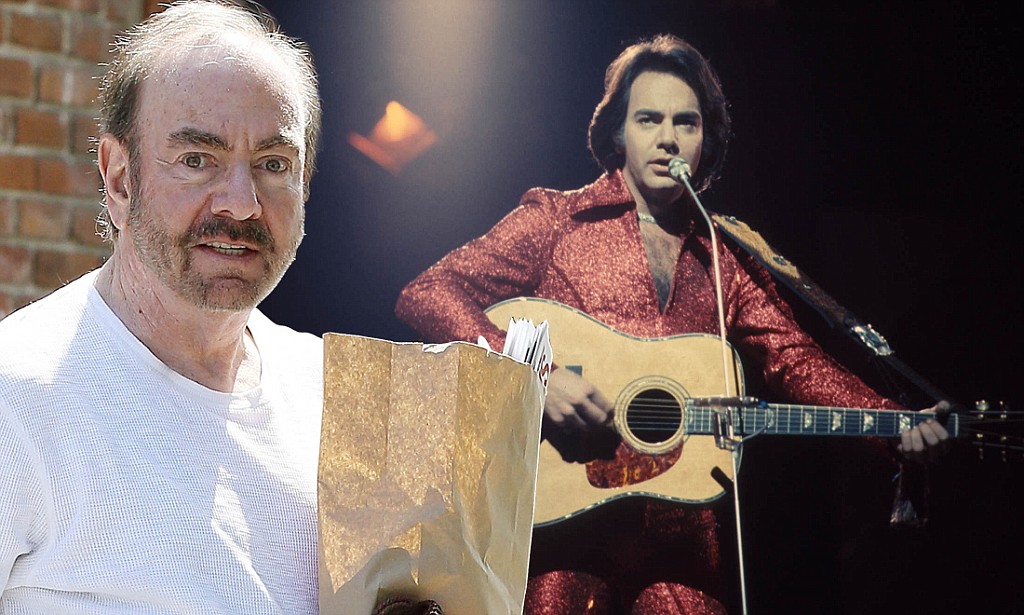
Not every Neil Diamond hit arrived with a shout. In 1976, Don’t Think… Feel proved that a quieter groove from Beautiful Noise could carry its own kind of authority.
Released as a single from Neil Diamond’s 1976 album Beautiful Noise, Don’t Think… Feel found its strongest commercial footing on Billboard’s Adult Contemporary chart, where it reached No. 4. That detail matters, because it tells us something essential about the song and about Diamond in that moment. This was not simply a big-voiced arena performer chasing volume or drama. It was an artist working inside rhythm, mood, and restraint, letting his phrasing do part of the emotional work. In a decade when adult contemporary radio often became the meeting place for sophistication and accessibility, the song fit beautifully.
By the time Beautiful Noise arrived, Neil Diamond was already one of the most recognizable voices in American popular music. But the album itself carried a slightly different atmosphere from some of the more direct anthems that had shaped his image. Produced by Robbie Robertson, it had polish, but it also had texture. There was a sense that Diamond was leaning into craft in a new way, exploring arrangement and feel as much as hook. Don’t Think… Feel lives inside that space. Even its title suggests a small rebellion against overexplanation. The song does not lunge for attention. It glides toward it.
That may be one reason the Adult Contemporary audience embraced it so naturally. The AC chart has often rewarded records that know how to stay close to the listener rather than overwhelm them, and this single carries exactly that kind of intelligence. The groove is relaxed but not lazy. The melody has ease, yet it never drifts into the background. Diamond sings with a conversational confidence that keeps the performance grounded, as if he knows the song’s real strength lies in tone and timing. It is one of those recordings where the voice seems to smile without ever breaking character.
What makes the No. 4 showing especially interesting is that Don’t Think… Feel is not usually the first title mentioned when people begin listing Neil Diamond’s best-known recordings. That is precisely why the chart milestone deserves a second look. It reminds us that a catalog is never built only on the biggest blockbusters. Sometimes an artist’s identity is held together by songs that reveal flexibility, not just force. This single did that. It showed Diamond moving comfortably through a smoother, more rhythm-conscious setting while still sounding unmistakably like himself.
There is also something revealing about the way the song sits within the larger emotional architecture of Beautiful Noise. The album title suggests energy, city light, movement, and the thrill of performance, but Don’t Think… Feel approaches that idea from another angle. It suggests that noise is not always about volume. Sometimes it is the internal rush of instinct, attraction, momentum, and the little surrender that happens when analysis gives way to experience. Diamond had always been capable of direct emotional communication, but here he seems especially interested in atmosphere. The record breathes. It trusts the listener.
That trust is a large part of why the song still feels rewarding to revisit. It belongs to a period when adult contemporary records could be elegant without becoming distant, and warm without becoming soft-edged. The production is clean, but not sterile. The performance is controlled, but not cold. Diamond’s vocal presence remains the center of gravity, carrying the easy assurance of a performer who knows exactly how much to give. He does not overstate the song. He lets it settle in, which is often harder to do well than making a louder impression.
Looking back, the chart run to No. 4 on the Billboard Adult Contemporary chart feels less like a footnote and more like a clue. It points toward the breadth of Neil Diamond’s appeal in the mid-1970s and the way Beautiful Noise could yield more than one kind of satisfaction. Some songs announce themselves as milestones the moment they arrive. Others quietly earn their place over time, through mood, craft, and the kind of repeat listening that reveals deeper confidence. Don’t Think… Feel belongs to that second category. It is a reminder that in Neil Diamond’s hands, a measured performance could still leave a lasting mark, and that sometimes the most persuasive songs are the ones that seem to move with effortless ease while carrying far more intention underneath.
