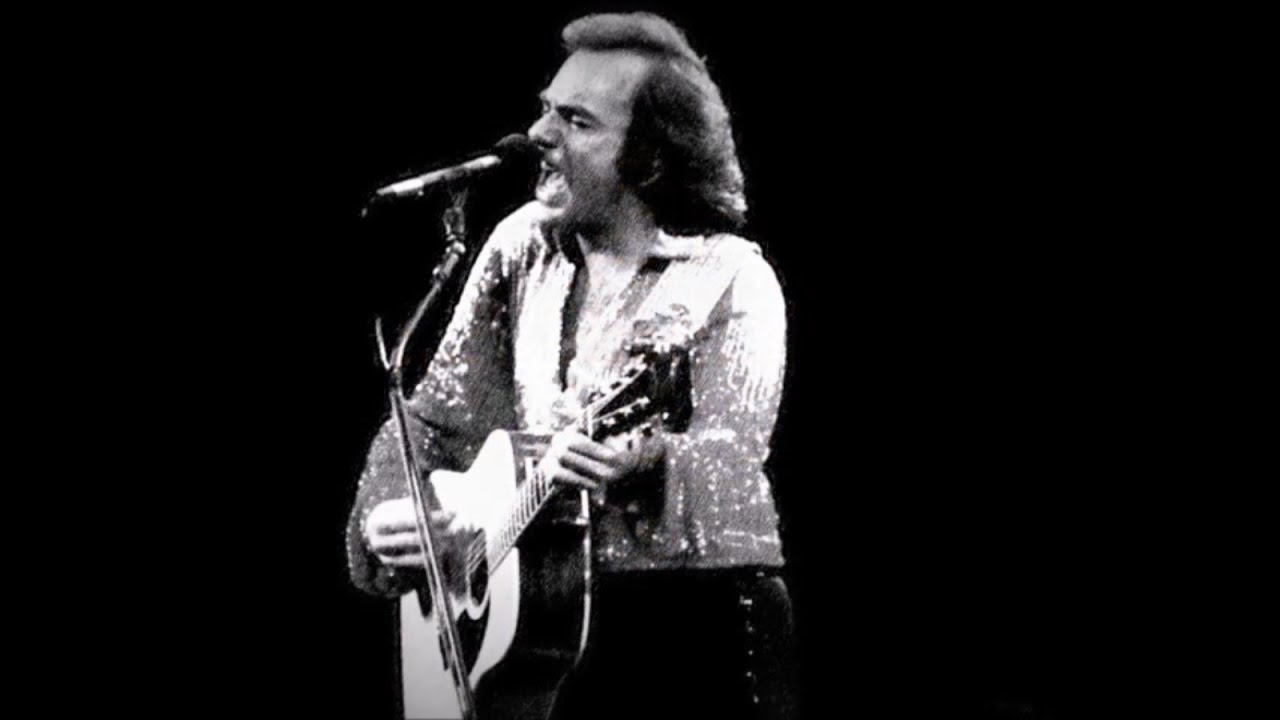
In 1984, Neil Diamond answered a changing radio landscape with a song that felt polished on the surface and quietly reflective underneath. Turn Around did not need to shout to matter; it simply found its place and stayed there.
Released in 1984 as the lead single from Primitive, Turn Around gave Neil Diamond one of his most solid Adult Contemporary successes of the decade, reaching the format’s top five and reminding listeners that his voice still had a natural home on the radio. That detail matters, because by the mid-1980s the pop landscape had changed dramatically. Production was sleeker, textures were brighter, and many artists from an earlier era were being forced into awkward reinventions. Diamond did not entirely resist the times on Primitive; he stepped into them. But with Turn Around, he also carried something unmistakably his own into that sound: a sense of inwardness, a feeling that even a radio-friendly single could hold a private pause inside it.
That is part of what makes the song’s chart showing more interesting than a simple statistic. A top-five Adult Contemporary record can sometimes suggest softness, safety, or easy familiarity. Turn Around is smoother than the dramatic storytelling of Diamond’s earlier peak years, but it is not empty polish. The song moves with a measured grace, and his vocal never overplays the emotion. Instead, he sings with the kind of controlled warmth that had long been one of his strengths. Even when surrounded by the clean surfaces of 1980s production, he sounds like a person thinking out loud rather than a machine delivering a format-perfect performance.
As the opening statement from Primitive, the single had an important job to do. It had to introduce the album’s mood, establish Diamond’s place in a new decade, and reassure longtime listeners that the emotional center had not disappeared. It succeeds because it does not behave like a desperate bid for youth. There is rhythm in it, brightness in it, and a contemporary radio sense in its arrangement, but the emotional motion is more mature than fashionable. The title itself suggests movement, reconsideration, the brief human instinct to look back before going on. That feeling sits beautifully in Diamond’s voice. He had always been able to make large emotions feel conversational, and here he does it in a more restrained register, which may be exactly why the song connected so strongly with Adult Contemporary audiences.
The mid-1980s could be a difficult place for singer-songwriters whose biggest cultural moments were already behind them. Some leaned heavily on nostalgia. Others chased trends so hard that they lost their own shape. What Neil Diamond managed on Turn Around was subtler. He accepted the era’s studio language without letting it erase his personality. The arrangement is neat, radio-shaped, and recognizably of its time, yet the performance still rests on that familiar Diamond blend of steadiness and yearning. He sounds less like a man trying to prove relevance than like one calmly inhabiting it.
That may be why the song’s Adult Contemporary top-five run still says something meaningful about his career. It was not merely another entry in a long discography. It showed that Diamond’s appeal could translate across eras when the material gave him room to be reflective rather than theatrical. He had built his name on bold choruses, dramatic declarations, and songs that seemed to reach for the last row of the arena. Turn Around works differently. It is smaller in gesture, more measured in atmosphere, and perhaps more revealing because of that. It asks the listener to come closer rather than stand back in admiration.
There is also something telling about the relationship between the song and the album that carried it. Primitive is often remembered as part of Diamond’s 1980s catalog rather than as one of the towering statements of his earlier years, yet lead singles shape memory. They create first impressions, and first impressions often decide whether an album era will be heard at all. By placing Turn Around at the front, Diamond introduced Primitive with a record that was accessible without being faceless. It had enough immediacy for radio, enough elegance for the Adult Contemporary audience, and enough emotional texture to sound like more than background music.
Listening now, the song also carries a quiet historical value. It captures a particular moment when established artists were negotiating new technology, new production ideals, and new expectations about what radio voices should sound like. Some recordings from that period feel trapped inside their decade. Turn Around certainly belongs to 1984, but it is not reduced by it. The production marks the year; the vocal keeps the song human. That balance is the reason its chart milestone still matters. It was not a fluke of familiarity. It was a sign that Neil Diamond, even in a more streamlined era, could still deliver a record that felt grounded, melodic, and emotionally lived-in.
And perhaps that is the lasting beauty of the song. It does not arrive like a grand declaration of survival. It simply stands there, poised and self-possessed, carrying a little reflection inside a little motion. In a career full of larger gestures, Turn Around endures as evidence that sometimes a quieter hit tells the fuller story.
