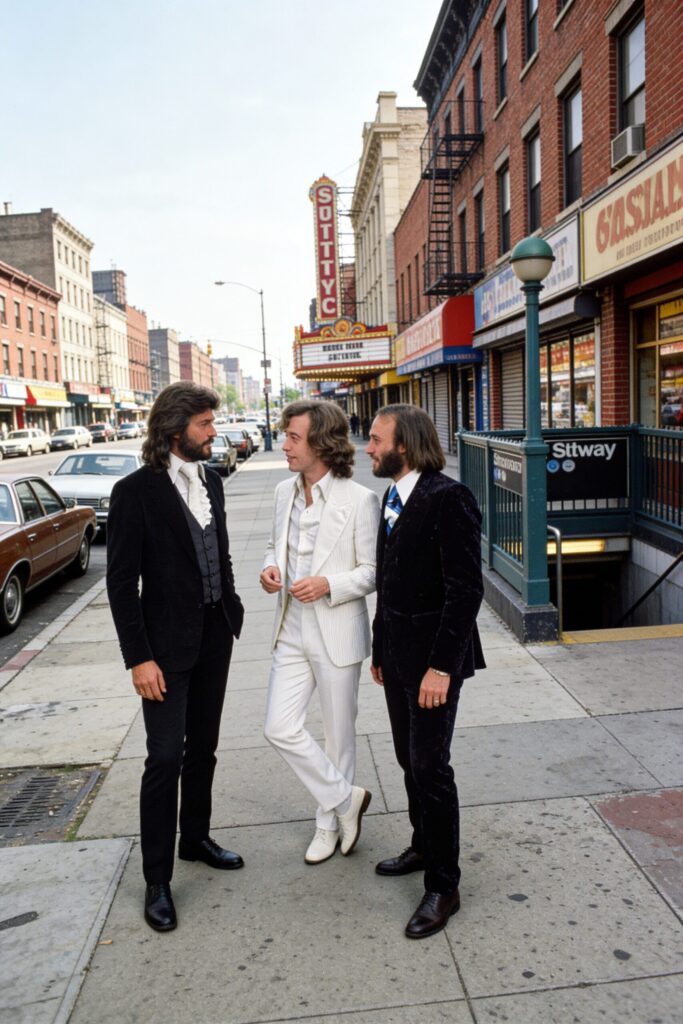
By 1987, You Win Again was more than a return for the Bee Gees—it was the sound of a group stepping back into the center of pop and quietly altering the record books.
Released in 1987 as the lead single from E.S.P., the Bee Gees’ first album of new studio material in six years, You Win Again arrived with unusual weight on its shoulders. The brothers had never stopped writing, and their names still carried enormous songwriting authority, but as recording artists they were stepping into a different climate than the one that had once made them unavoidable. The late 1970s had tied the Bee Gees to a cultural moment so massive that it eventually cast a shadow of its own. By the middle of the 1980s, a comeback single had to do more than sound good. It had to sound necessary.
That is part of what makes You Win Again such a fascinating record. Written by Barry, Robin, and Maurice Gibb, it did not chase nostalgia, and it did not plead for affection. Instead, it came in with sleek confidence: a clipped rhythm, a sharp electronic pulse, a chorus built to strike fast and stay lodged in memory. The song carried the Bee Gees’ melodic instinct, but the production belonged fully to its moment. It was polished, cool, and modern without feeling anonymous. Rather than trying to recreate the heat of the disco years, the group found a new way to sound unmistakably like themselves.
In the United Kingdom, the response was immediate and historic. You Win Again went to No. 1, giving the Bee Gees a chart-topping British single in a third consecutive decade. That achievement mattered for more than statistical reasons. It placed the group in a rarified space in pop history, making them the first group to reach the top of the UK chart in the 1960s, 1970s, and 1980s. For an act so often discussed in chapters—early harmony pop, psychedelic sophistication, soundtrack-era dominance—this single stitched those chapters together. It said that the story had not broken. It had continued.
The milestone is even more striking when you think about how different the Bee Gees sounded in each of those eras. The group that gave the world Massachusetts was not the same group that made Night Fever, and neither of those versions is identical to the one heard on You Win Again. Yet what held across the decades was a particular emotional architecture: melodies that balanced ache and elegance, choruses that felt both immediate and strangely haunted, harmonies that could suggest intimacy even inside a heavily produced pop record. That continuity is why the comeback worked. The surface changed, but the instinct underneath remained intact.
There is something especially compelling about the song’s emotional stance. You Win Again is built around surrender, but not in a soft or defeated way. It moves with the tension of someone who already knows the outcome and keeps stepping forward anyway. The title itself sounds almost conversational, even resigned, but the music turns that resignation into momentum. Barry Gibb’s lead vocal gives the song its edge, while the brothers’ collective sense of arrangement keeps the whole thing suspended between vulnerability and control. It is one of those records that sounds brisk on the radio yet reveals a deeper strain of weariness when heard closely.
That quality helped the single resonate as more than a chart event. A comeback song can sometimes sound like a campaign. You Win Again does not. It sounds like a group with nothing to prove choosing, instead, to be sharp, current, and exact. The Bee Gees had spent the first half of the decade writing and producing major hits for other artists, and that craftsmanship is all over this track. Every section arrives with purpose. Nothing sprawls. The hooks are disciplined. The atmosphere is controlled. Even the sheen of the production feels strategic, as though the group understood that returning successfully in 1987 required precision, not spectacle.
And yet the song never feels cold. That may be the quiet triumph of the record. Beneath the electronic textures and crisp rhythm, there is still a human pulse that belongs to the Gibbs alone. Their music often carried a bittersweet tension: bright surfaces, darker undercurrents. You Win Again belongs to that tradition. It is catchy enough to dominate the chart, but it also carries the maturity of artists who knew what public adoration could do, and what it could take away.
So the real power of the single is not only that it restored the Bee Gees to commercial prominence in Britain. It is that it reframed them. E.S.P. was not merely a return after silence; it was evidence that reinvention did not require self-erasure. With You Win Again, the Bee Gees stepped back into the pop conversation and did something rarer than a comeback. They made history sound contemporary. Even now, the record carries that double charge: the thrill of a hit and the deeper satisfaction of hearing a great group prove, once again, that time had not finished with them.
