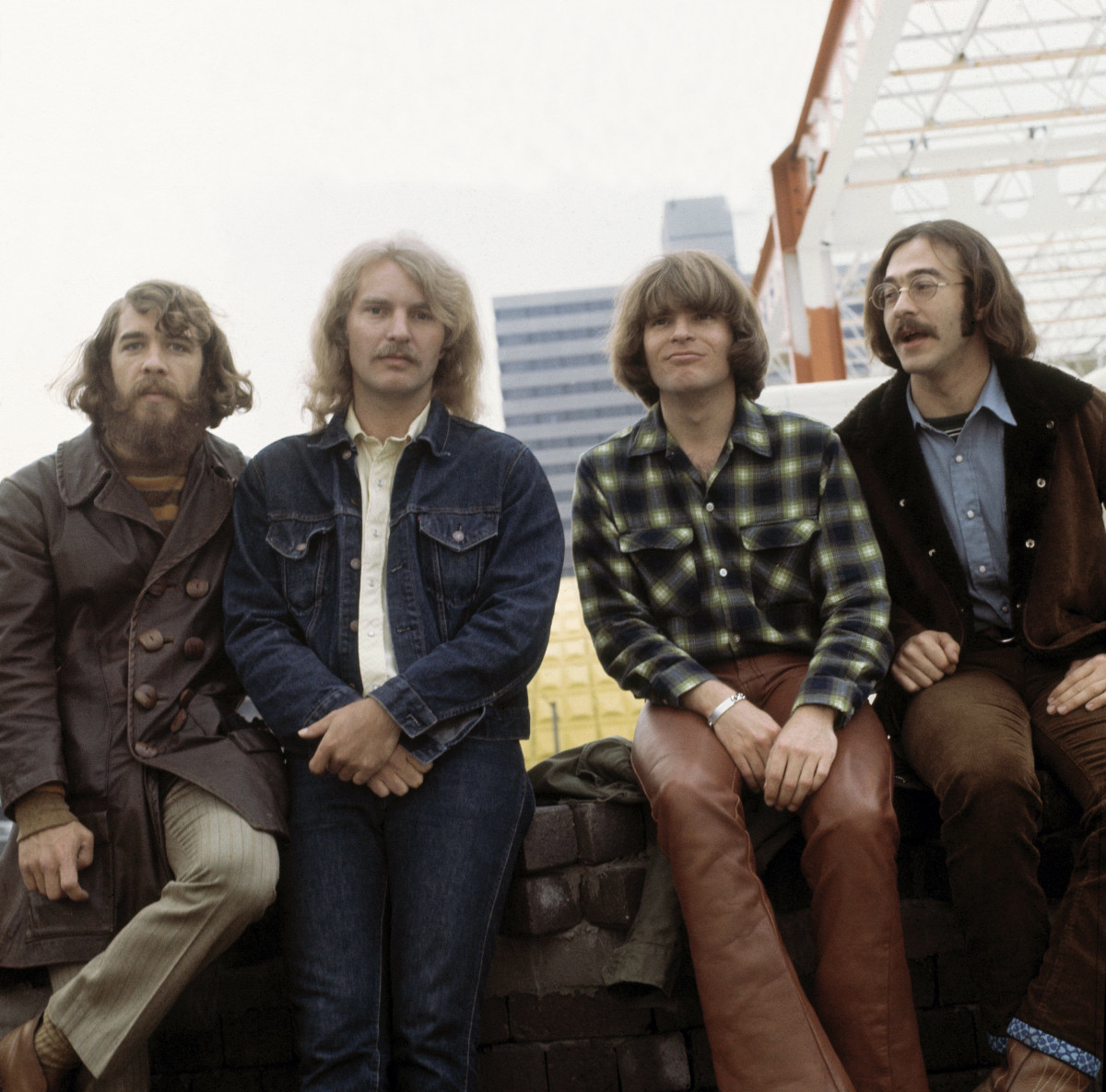
Before Cosmo’s Factory settles into its run of hits and hard-driving confidence, Creedence Clearwater Revival begins with a challenge: Ramble Tamble, seven minutes of motion, tension, and John Fogerty pushing the band past its usual borders.
When Creedence Clearwater Revival released Cosmo’s Factory in 1970, they were already one of the most reliable hit-making bands in America. Their records moved with unusual force: short songs, sharp hooks, lean arrangements, and a sense that every note had been stripped of excess. That is exactly why Ramble Tamble, the album’s opening track, still feels so striking. At more than seven minutes, it does not behave like the sort of song people expected from the group. Instead, it announces, almost immediately, that John Fogerty was interested in more than repeating a winning formula.
Written by John Fogerty and placed at the very front of an album packed with familiar titles, Ramble Tamble works like a statement of intent. Before the listener reaches the concise punch of Travelin’ Band or the worn wisdom of Who’ll Stop the Rain, this opener jolts the room awake. Its first movement is tight, wiry, and fast, built on a charged rockabilly pulse that sounds both playful and aggressive. The rhythm section of Stu Cook and Doug Clifford keeps it moving with a clipped, muscular urgency, while the guitars snap and grind around the beat. It has the drive of a road song, but there is friction in it too, as if the wheels are spinning a little hotter than they should.
That opening alone would have made the track memorable. But what gives Ramble Tamble its hold on listeners is the long turn it takes in the middle. The song opens out, the structure loosens, and the performance enters a more searching space. This is where Fogerty’s guitar work becomes central to the story. He does not simply solo in the usual rock sense. He creates pressure. The lines twist, repeat, bite, and stretch against the groove, while the band holds together with a sense of mounting unease. What begins as bar-band velocity gradually becomes something closer to a fevered journey, suspended between control and release.
That shift matters because it reveals something essential about Creedence Clearwater Revival. The band is often remembered through shorthand: swamp rock, roots rock, American singles made for radio and jukeboxes. Those descriptions are not wrong, but they can make the group seem narrower than it was. Ramble Tamble reminds us that CCR could absorb the atmosphere of the late 1960s and early 1970s without losing their own discipline. The song brushes against psychedelic feeling, yet it never drifts into vagueness. Even at its most expansive, it sounds purposeful, tense, and physical. The trip is not dreamy. It is restless.
That restlessness also suits Cosmo’s Factory as an album. Released in a year when American music felt crowded with noise, speed, and contradiction, the record manages to sound both efficient and large-hearted. It contains hit singles, deep cuts, and memorable covers, but Ramble Tamble gives the album its first dramatic shadow. It tells the listener that this is not merely a collection of polished songs. There is heat here, and strain, and ambition. Fogerty, who exerted tight creative control over the band’s recordings, seems to be testing how much intensity the group can carry without breaking its compact identity.
The beauty of the track is that its ambition never feels decorative. Ramble Tamble is not long for the sake of being long. Its length allows the tension to accumulate in real time. The early section kicks up dust; the middle section clouds the horizon; the return feels like the band fighting its way back into daylight. That arc gives the song an unusual emotional shape for CCR. It is exciting, but not easy. It moves, but not peacefully. There is a sense of impatience running through it, as though motion itself has become a kind of pressure.
And then there is the sound of John Fogerty at the center of it all. His gift as a singer was always tied to grit, attack, and precision, but on Ramble Tamble his guitar says just as much as his voice. The rockabilly edge in the opening keeps the track rooted in American rhythm and drive, while the extended instrumental section lets him lean into something more volatile and atmospheric. He does not abandon the band’s identity; he stretches it until new colors appear. That is one reason the song remains such a revealing part of the Cosmo’s Factory story. It captures a band known for economy choosing, for one remarkable opening statement, to let the road run longer.
For listeners coming back to the album decades later, Ramble Tamble still lands with a special kind of surprise. It is not the most famous song in the Creedence Clearwater Revival catalog, and maybe that helps. It arrives without the weight of constant radio repetition. What remains is the thrill of hearing a great band step slightly outside the frame people built around it. On an album filled with songs that feel instantly familiar, this opener still feels like a risk, a test, and a release. It does not simply begin Cosmo’s Factory; it unsettles it in the best possible way.
