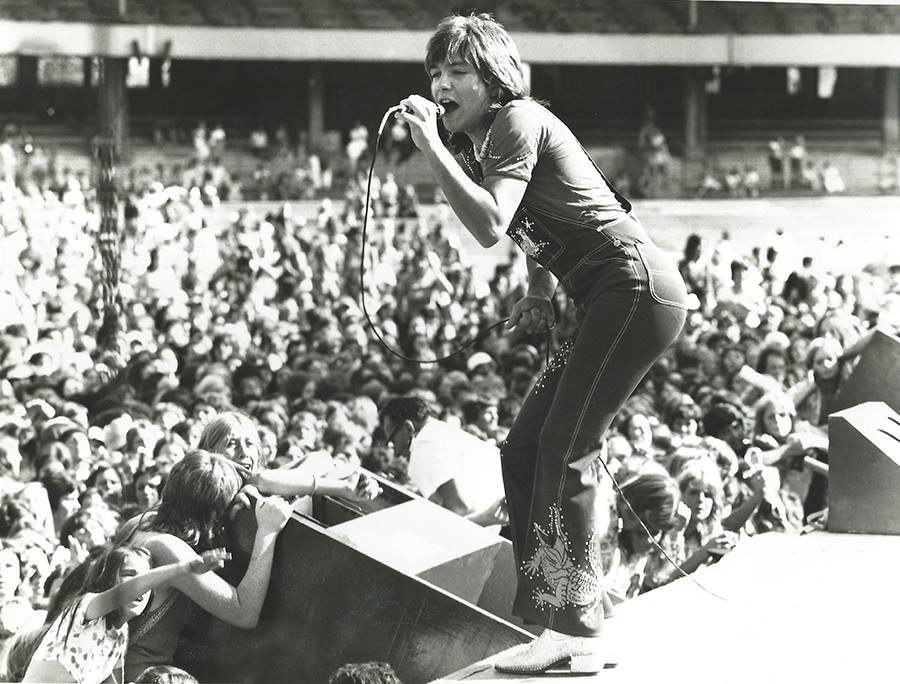
On the flip side of a 1972 hit, Blind Hope revealed a quieter, more inward David Cassidy than the teen-idol headlines ever could.
There is something especially moving about a song that was never meant to be the main attraction. In 1972, David Cassidy‘s Could It Be Forever became a major hit, reaching No. 2 on the UK Singles Chart and further confirming that his fame had grown far beyond television stardom. Yet on the back of that successful single sat Blind Hope, a B-side that many casual listeners missed at the time. For those who return to it now, that reverse side feels less like filler and more like a small, telling confession hidden in plain sight.
By then, Cassidy was already one of the defining pop faces of the early 1970s. Through The Partridge Family, and through solo successes that traded on youth, charm, and instant melodic appeal, he had been placed inside one of the most powerful dream-machines in popular music. Songs such as I Think I Love You and Cherish helped establish an image that was bright, accessible, and emotionally direct. The public knew the smile, the hair, the magazine covers, the stage frenzy. What fewer people were encouraged to notice was how capable he was of shading a lyric with uncertainty, fatigue, tenderness, and restraint.
That is why Blind Hope matters. As the B-side to Could It Be Forever, it arrives in direct contrast to the expectation surrounding a David Cassidy single in 1972. The A-side carries the commercial lift, the clear romantic sweep, the kind of polished optimism that a hit single was supposed to deliver. Blind Hope, by comparison, turns inward. It does not reach for the crowd in the same way. It lingers in a more private emotional space, and Cassidy meets that space with a vocal that feels measured rather than performative. He sounds less like a poster on a bedroom wall and more like a young man thinking aloud.
That distinction is the heart of the song’s power. A great many teen idols have made records that succeeded because they fit the image first and the artist second. Blind Hope is memorable because it seems to reverse that order. Even if it never had the chart life of its companion side, it offers a different kind of evidence about Cassidy’s musical instincts. He was not simply a vehicle for bright hooks and arranged excitement. He could also hold still inside a song. He could suggest vulnerability without overselling it. He could let uncertainty remain uncertainty, which is often what makes a performance last.
There is also a larger historical reason this B-side deserves reappraisal. In the era of 45s, the back of a single could become a curious little archive of an artist’s hidden range. Labels often pushed the obvious hit to the front and left subtler material behind it, where only dedicated buyers might hear it. That is exactly the sort of setting in which a song like Blind Hope could be overlooked for decades. But heard now, away from the commercial rush of 1972, its quietness feels almost radical. It asks the listener to come closer rather than clap louder.
The title itself tells part of the story. Blind Hope is not a phrase of confidence so much as one of emotional risk. It suggests holding on without guarantees, believing because there is little else to do. Cassidy’s vocal suits that ambiguity beautifully. He does not flatten the feeling into simple heartbreak or simple reassurance. Instead, he inhabits the uneasy middle ground, where longing and doubt live side by side. For a singer whose early fame was often packaged in broad strokes, that kind of nuance is no small thing.
What makes the record even more affecting in hindsight is how it complicates the common memory of David Cassidy. Too often, his early career is summarized through spectacle: the crowds, the posters, the speed of the ascent. All of that is real, but it is not the whole truth. Songs like Blind Hope remind us that even within the machinery of pop stardom, he was searching for room to sound more human, more reflective, more emotionally precise. One of the quiet pleasures of listening back is realizing that the clues were there all along, tucked into places the market did not spotlight.
So when people revisit Could It Be Forever, it is worth turning the record over, at least in spirit. The hit still shines, and it deserves its place in the story. But the B-side deepens that story. Blind Hope does not reject the early David Cassidy image; it gently opens it from within. In doing so, it gives us one of those rare pop artifacts that feels more intimate with time, not less. The song may have begun life as a secondary track, but today it stands as a persuasive reminder that some of an artist’s most revealing moments are the ones the charts never had room to measure.
