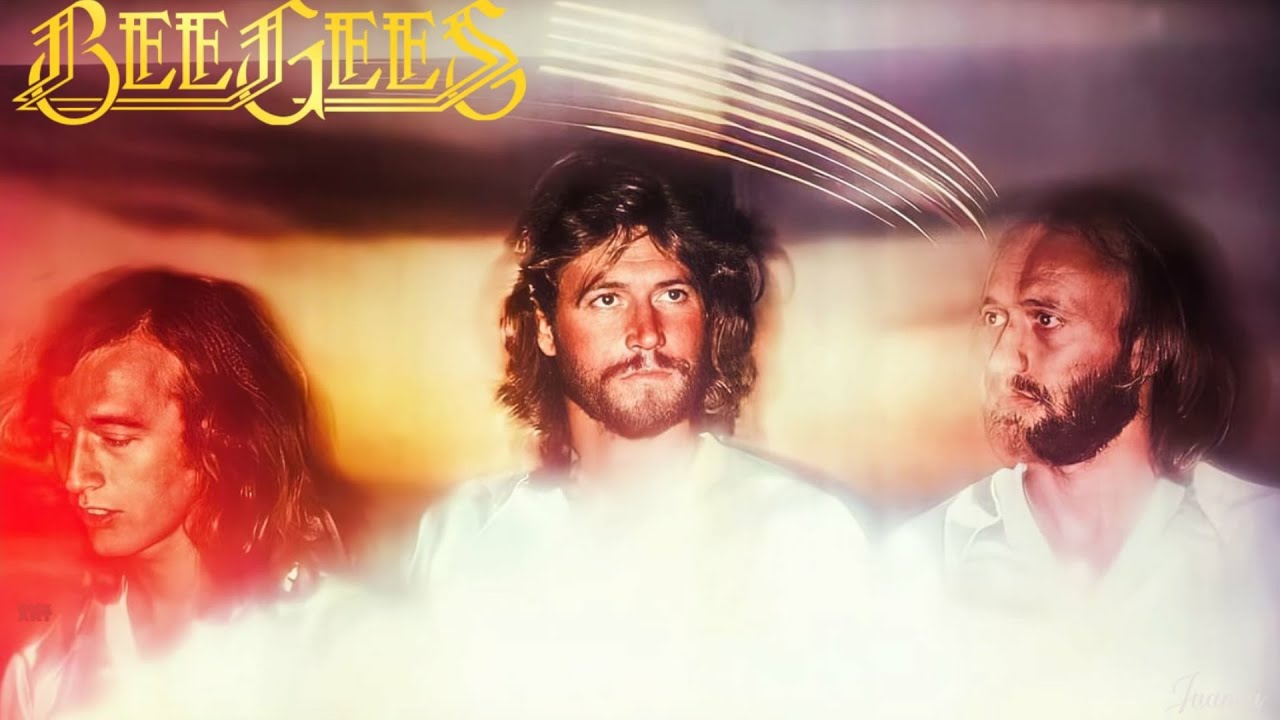
A sleepless, tender reflection on love and uncertainty, The Longest Night reveals the quiet emotional heart beating beneath the Bee Gees‘ polished 1987 comeback.
The Longest Night is one of those songs that never came with the noise of a hit single, and perhaps that is exactly why it still feels so personal. Released on E.S.P. in 1987, it arrived during a major return for the Bee Gees, their first studio album of new material since Living Eyes in 1981. The charts that year were dominated by the enormous success of You Win Again, which reached No. 1 in the UK, while E.S.P. itself became a British Top 5 album and re-established the group strongly across Europe. The Longest Night, however, was not issued as a single, so it had no chart life of its own. It lived deeper inside the album, waiting for listeners who stayed after the headlines faded.
That is often where the most revealing Bee Gees songs can be found. Not always in the giant singles everyone remembers first, but in the album tracks where the brothers let mood, harmony, and emotional shading do the real work. By the time Barry Gibb, Robin Gibb, and Maurice Gibb made E.S.P., they were returning not as newcomers chasing relevance, but as master songwriters with nothing left to prove. The first half of the 1980s had already shown how powerful they still were behind the scenes, writing and producing for other artists and leaving fingerprints on major pop records. Yet E.S.P. mattered because it brought them back into the frame as the Bee Gees themselves.
And that is part of what makes The Longest Night so affecting. It does not sound like a song desperate to announce a comeback. It sounds like a song content to speak softly and trust the listener to come closer. The late-1980s production is certainly there: the sleek surfaces, the measured rhythm, the synthesizer atmosphere, the carefully shaped adult-pop sheen. But beneath that studio gloss is something older and more lasting, something that had always been central to the group at their best: a feeling of emotional endurance, of people trying to survive the hours when love becomes doubt, silence, memory, and waiting.
The title itself says almost everything. The Longest Night is not just a night on the clock. It is the emotional stretch of time when a relationship feels unresolved, when the mind cannot rest, when memory keeps reopening the same wound. That was always one of the quiet strengths of the Bee Gees. Even at their most polished, they understood how to write songs about inner weather. A storm did not need to be loud to be real. In this song, the ache is controlled, almost elegant, and that restraint makes it feel even more convincing.
There is no giant public myth attached to The Longest Night, no famous scandal, no over-told studio anecdote that has swallowed the music itself. In a way, that absence has protected it. The song can still be heard for what it is: an overlooked piece of craftsmanship from an album too often reduced to its biggest single. If You Win Again was the triumphant public face of E.S.P., then The Longest Night was part of its private soul. It reminds us that comeback records are rarely just about victory. They are also about vulnerability, about whether artists can still speak intimately after the world has spent years talking loudly about them.
Musically, the song carries that mood with great intelligence. The arrangement does not rush toward release. Instead, it allows the melody to unfold with patience, supported by the unmistakable harmonic instinct that made the Bee Gees so distinctive across decades. Even when the production bears the stamp of 1987, the emotional architecture feels timeless. This is not a novelty of the era. It is a familiar human condition dressed in the sound of its moment. That combination is one reason many deep cuts outlast trendier hits in the hearts of devoted listeners.
There is also something quietly moving about hearing a song like this on E.S.P.. After years in which the brothers had been discussed through industry narratives, through genre labels, through the long shadow of disco, The Longest Night restores the more intimate truth. The Bee Gees were, before anything else, great writers of melancholy. Great builders of atmosphere. Great arrangers of emotional hesitation. They knew how to give loneliness shape without making it melodramatic. They knew how to write about distance without draining the song of warmth.
That is why the track still matters. Not because it changed radio history. Not because it was pushed as a major single. It matters because it reveals the depth of E.S.P. beyond its commercial narrative. For listeners willing to move past the obvious entry points, The Longest Night offers a fuller portrait of where the Bee Gees stood in 1987: seasoned, vulnerable, contemporary, and still deeply melodic. It is the kind of song that grows stronger with time because it was never exhausted by overexposure.
In the end, The Longest Night feels like one of those hidden rooms in a familiar house. You think you know the place, then one evening you open a quieter door and discover a space filled with memory, shadow, and grace. That is the gift of an overlooked song. It returns the artist to you in a more human scale. And in the case of the Bee Gees, it reminds us that even in their comeback years, some of their most lasting truths were spoken in a lower voice.
