
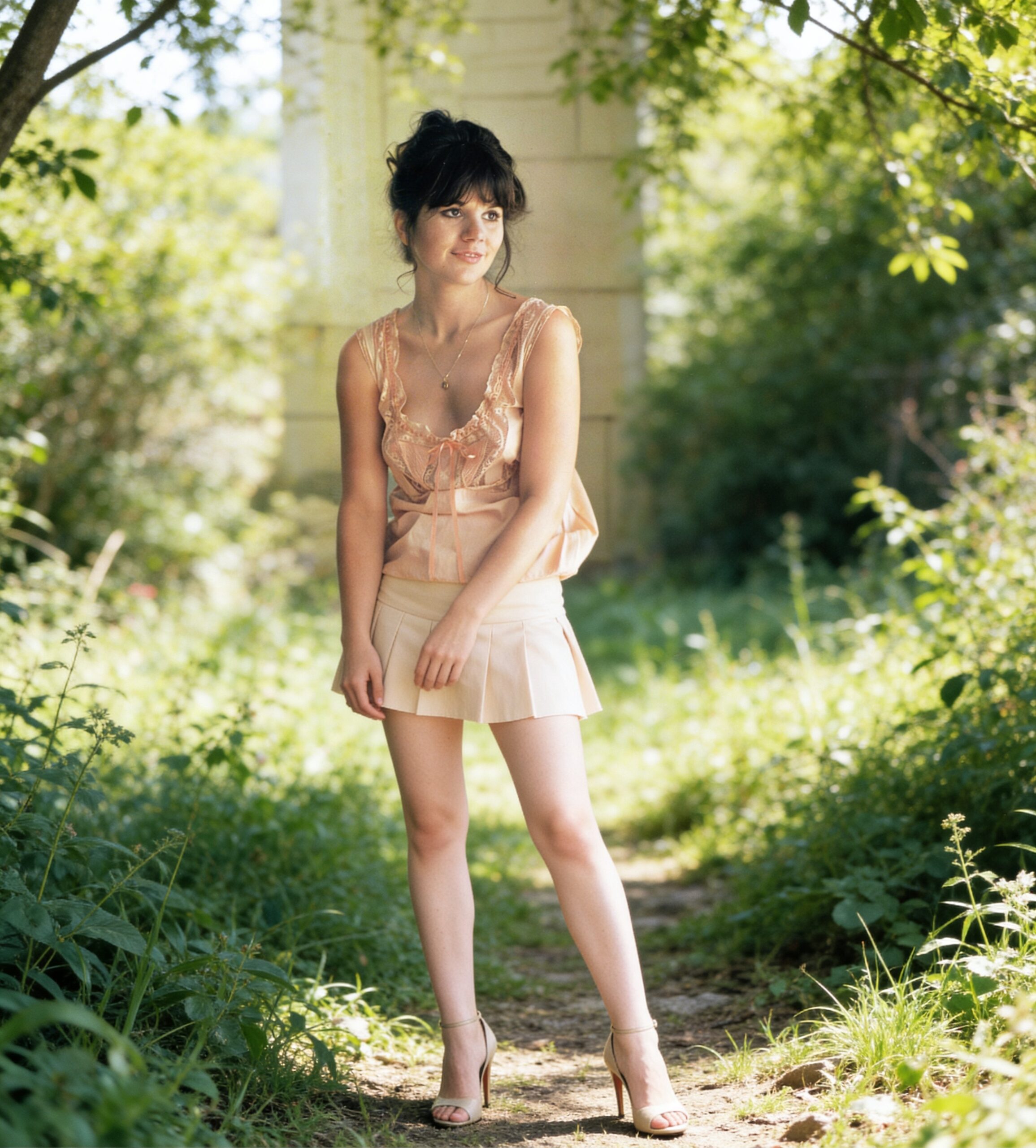
On ‘Round Midnight in 1986, Linda Ronstadt sang I’m a Fool to Want You with Nelson Riddle and His Orchestra and turned a classic torch song into one of the most graceful cross-genre moments of her career.
There are performances that do not need spectacle because the stillness does everything. Linda Ronstadt’s 1986 reading of I’m a Fool to Want You on ‘Round Midnight, backed by Nelson Riddle and His Orchestra, belongs to that rare category. By then, Ronstadt had already conquered rock, country-rock, and pop, yet this appearance showed something even more impressive: not range for its own sake, but discipline, taste, and the confidence to stand inside a song that had long been treated as sacred ground. The result was not a crossover gimmick. It was a meeting point between modern popular fame and the older, bruised elegance of the American standard.
The timing matters. Although Ronstadt had recorded I’m a Fool to Want You earlier for her 1984 album Lush Life, the 1986 television performance arrived when her work with Nelson Riddle no longer looked like a surprising detour. It had become one of the defining artistic turns of her career. What’s New, the first Ronstadt-Riddle album, reached No. 3 on the Billboard 200 in 1983, a remarkable chart showing for an album of pre-rock standards. Lush Life followed by climbing to No. 13 in 1984. Those numbers are important because they tell us this music was not being politely admired from a distance; it was being heard, bought, and loved on a large scale. Ronstadt had proved that the Great American Songbook could live again in the hands of an artist shaped by a completely different era.
That is what makes this ‘Round Midnight performance so moving from a cross-genre perspective. Ronstadt did not leave herself behind when she sang with Riddle. She brought into this repertoire everything she had learned from rock ballads, country sorrow, and West Coast pop clarity. Yet she also understood that these songs demand restraint. There is no hiding place in a standard like I’m a Fool to Want You. Written by Frank Sinatra, Jack Wolf, and Joel Herron, and first introduced by Sinatra in 1951, the song has always carried a sense of adult defeat. It is not about the thrill of being in love. It is about knowing better and returning anyway. Few popular songs admit weakness so directly.
That biographical shadow has always hovered over the song as well. Many listeners have long associated Sinatra’s original recording with his turbulent feelings for Ava Gardner, and whether one treats that link as history or as part of the song’s mythology, the lyric feels painfully personal. Ronstadt wisely avoided trying to out-Sinatra Sinatra. Instead, she sang it as if she were discovering the hurt in real time. Her phrasing is measured, never showy, and that is precisely why it cuts so deeply. She does not attack the song; she lets it settle. Every line sounds weighed before it is released.
Nelson Riddle and His Orchestra deserve equal credit for the emotional architecture of the performance. Riddle had been one of the great arrangers of American popular music, famous for wrapping singers in orchestral color without smothering their humanity. Here, the arrangement does exactly that. The strings move like memory rather than decoration. The brass is controlled, almost courtly. The rhythm does not press forward; it breathes. In a late-night setting such as ‘Round Midnight, that kind of arrangement feels even more intimate. The space around the vocal becomes part of the story. Silence, in this performance, is not emptiness. It is the sound of someone understanding the cost of what she is singing.
What also lingers is the contrast between Ronstadt’s public image and the emotional world of this song. This was an artist many first met through radio hits, arena-sized popularity, and a voice strong enough to cut through the bright production of the 1970s. But her standards period revealed another power entirely: the ability to stand nearly motionless inside a melody and make understatement feel immense. That is why this 1986 performance still matters. It reminds us that genre is often a shallow label compared with interpretation. A great singer does not merely change styles; a great singer finds the common human truth that links them.
And the truth inside I’m a Fool to Want You is devastatingly mature. The lyric is about surrender without innocence. It is about repeating an emotional mistake while fully aware of its consequences. That is why the song has outlived fashion, and why Ronstadt was such an unexpectedly ideal interpreter. She had always been capable of longing, but with Nelson Riddle, longing became quieter, wiser, and more wounded. In her hands, the song stops being just a classic standard and becomes something closer to private reckoning.
Seen that way, the 1986 ‘Round Midnight version is more than a fine vocal performance. It is a small lesson in artistic courage. Linda Ronstadt stepped across generations, across audiences, and across assumptions about what kind of singer she was supposed to be. Instead of sounding borrowed, the old song sounded newly inhabited. That is why this performance still has such force today. It is not only beautiful. It is honest in a way that cannot be faked, and elegant in a way that never asks for applause.
