
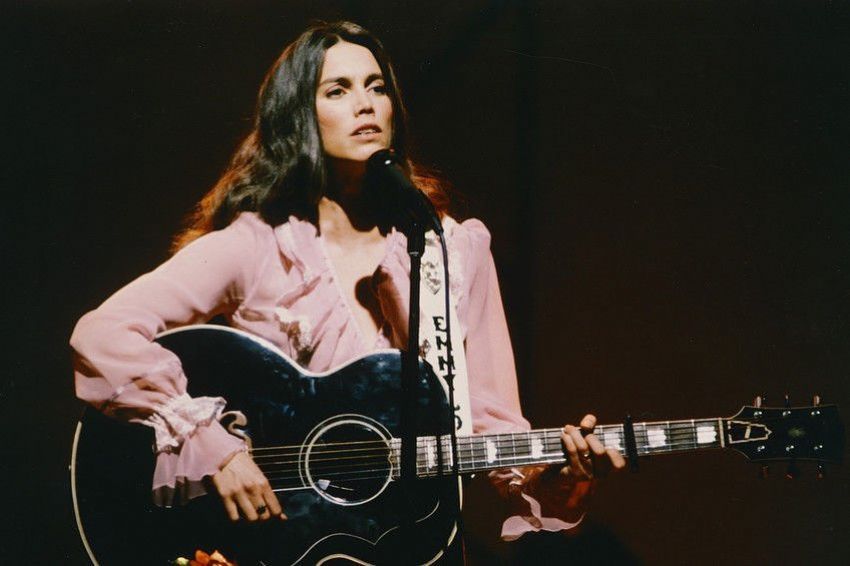
In Emmylou Harris’ reading of Bright Morning Stars, an old spiritual becomes a tender meditation on faith, longing, and the light that somehow survives the darkest hours.
Bright Morning Stars is not remembered because it stormed the charts. When Emmylou Harris recorded the song for her 1987 album Angel Band, it was not issued as a major Billboard country single, and that fact says a great deal about its character. This is not a performance shaped for commercial urgency or radio drama. It lives in another tradition altogether: the tradition of songs passed hand to hand, voice to voice, heart to heart. In that sense, its power is far greater than a chart position could ever measure.
The song itself comes from older American sacred music, rooted in Appalachian and Southern spiritual tradition. It is often connected to the hymn family known as Bright Morning Stars Are Rising, a song of devotion and yearning that has traveled through generations in slightly different forms. Its imagery is simple, almost elemental: morning stars, a breaking day, loved ones remembered, souls reaching toward comfort. Yet those plain words carry an emotional weight that many polished modern songs never touch. They speak of endurance. They speak of hope that arrives quietly, not triumphantly. They speak of a faith that is less about performance than about holding on.
That made Angel Band the ideal home for it. By the time this album arrived, Emmylou Harris had already built one of the most admired catalogs in country and roots music. She could move from heartbreak ballads to honky-tonk fire, from country-rock elegance to deep traditional material, and always sound unmistakably herself. But Angel Band offered something especially intimate: a return to gospel feeling, acoustic textures, and the old songs that seem to stand outside fashion. In that setting, Bright Morning Stars does not feel like a track placed on an album. It feels like a room being opened.
What gives Harris’ version such lasting grace is restraint. She never oversings it. She never forces the emotion. Her voice, so often described as clear and ethereal, carries the song with a kind of luminous patience. There is a stillness in the performance that draws attention not to the singer’s virtuosity, but to the song’s spiritual center. Many artists can sing beautifully; far fewer understand when beauty must remain humble. Emmylou Harris understood that instinctively. She lets the melody breathe, and by doing so, she lets the listener feel the centuries behind it.
The meaning of Bright Morning Stars is deeply bound up with consolation. The song looks toward light, but it never pretends darkness is not real. That is why it lingers. It does not deny sorrow, separation, fatigue, or uncertainty. Instead, it answers them with gentleness. The image of day breaking in the soul is one of the most moving ideas in old sacred music, because it suggests that renewal begins inwardly. Before the world changes, something changes inside the heart. Harris captures that beautifully. Her performance does not shout salvation; it suggests reassurance. It is a song for moments when certainty feels fragile and yet the need for comfort feels immediate.
There is also something profoundly communal about the piece. Traditional spirituals were never meant to belong to one star or one era. They belong to gatherings, to family memory, to front porches, church pews, back roads, and private reckonings no audience ever sees. That is one reason Bright Morning Stars feels so moving in Harris’ hands. She approaches it not as an owner, but as a caretaker. She receives the song with reverence and passes it forward without crowding its origins. In a music industry so often built on reinvention, that kind of humility can feel almost startling.
For listeners who know Emmylou Harris first through her more widely recognized country recordings, this song reveals another side of her artistry. It reminds us that one of her greatest gifts was never merely style. It was discernment. She knew how to find material with roots. She knew how to honor old language without making it sound like a museum piece. And she knew that a quiet performance, when sung with conviction, can carry more emotional truth than the grandest production.
That is why Bright Morning Stars still reaches people so deeply. It does not belong to the restless world of disposable hits. It belongs to the older world of songs that accompany human beings through doubt, memory, prayer, and perseverance. On paper, it may look modest beside charting singles and career-defining anthems. In feeling, it is anything but modest. It is one of those recordings that seems to glow from within.
And perhaps that is the lasting story of Bright Morning Stars. It was never a chart event, never a loud cultural phenomenon, never a song that needed spectacle to survive. Instead, on Angel Band, Emmylou Harris gave it what it needed most: honesty, space, and a voice capable of making an old spiritual sound both ancient and immediate. Some songs entertain for a season. This one keeps watch. It waits quietly, like morning light at the edge of the window, and every time you return to it, it reminds you that calm can be powerful, memory can be sacred, and the softest songs often endure the longest.
