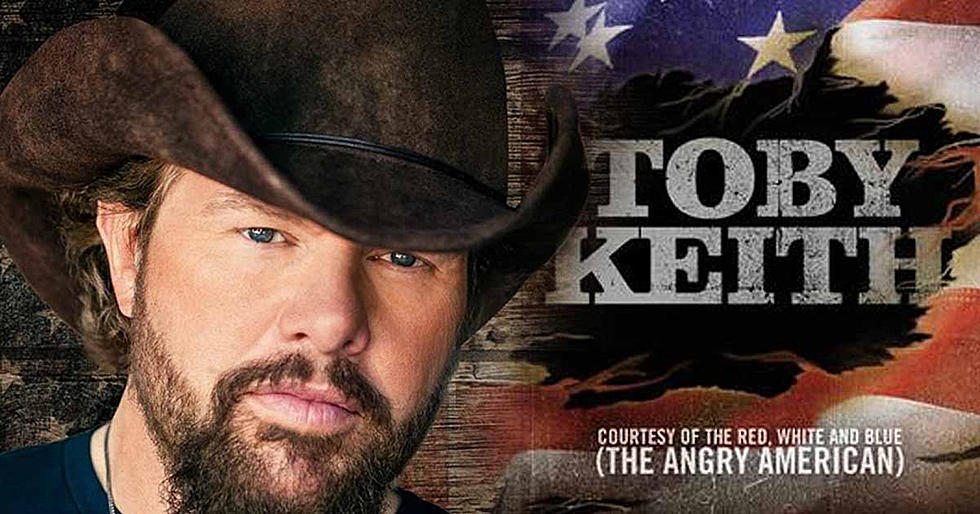
“Courtesy of the Red, White and Blue (The Angry American)” is a blunt, bruised postcard from a wounded moment in U.S. history—grief and fury fused into a chorus that refuses to whisper.
Released on May 27, 2002, Toby Keith’s “Courtesy of the Red, White and Blue (The Angry American)” didn’t ease its way into the world—it arrived with clenched teeth. It debuted at No. 41 on Billboard’s Hot Country Songs (week of May 25, 2002) and climbed to No. 1 for the week of July 20, 2002. It also crossed into the mainstream as a pop hit, reaching No. 25 on the Billboard Hot 100.
The song was the lead single from Unleashed (released August 6, 2002), the album that marked a commercial turning point for Keith—his first to reach No. 1 on the U.S. Billboard 200, carrying his brand of plainspoken country into full national dominance.
But charts only tell you how far it traveled, not why it hit so hard.
The story behind it is as personal as it is historical. Keith wrote the song in late 2001, shaped by two shocks: the death of his father in March 2001, and the September 11 attacks later that year. In the early days, he didn’t even want to record it—he kept it as something he sang live for military audiences. Then, as the story goes, Marine Corps Commandant James L. Jones told him it was, in effect, his way to serve: to lift morale, to speak the unsaid out loud.
That origin matters because “Courtesy of the Red, White and Blue” doesn’t feel like a studio invention. It feels like a man pacing the floor, too angry to sit down, turning emotion into meter. The lyric is deliberately plain, almost conversational—built to be shouted from a crowd, not studied in a quiet room. And yet, beneath the bark and bravado, there’s a recognizable human ache: the sense that the world you trusted to remain stable has suddenly become breakable.
The meaning of the song lives in its tension. On one hand, it’s a tribute—an inheritance of patriotism passed from a veteran father to a son who now sees the homeland attacked. On the other, it’s a release valve: rage given a melody so it can be carried, shared, and—depending on who’s listening—either celebrated as catharsis or condemned as escalation. Keith himself later framed it as something that “leaked out” of him after the attacks, never meant to please everyone.
That is why it became a lightning rod. In 2002, ABC invited Keith to perform on a patriotic special, but host Peter Jennings reportedly asked him to soften the lyric or choose another song; Keith refused and did not appear—an episode that only amplified the song’s visibility. The backlash and debate didn’t slow it down; if anything, they made it feel even more like a cultural flare shot into the sky.
And then there was the wider country-music drama of the era—the public feud with the Dixie Chicks, sparked in part by their criticism of the song and the politics swirling around it. For a while, the track didn’t just represent a mood; it became a line people stood on—proof that a three-minute single can function like a headline, a badge, or a provocation, depending on the ears that meet it.
Still, set aside the noise, and what remains is the uncomfortable truth the song captures: there are moments when a nation doesn’t speak in poetry. It speaks in blunt force. “Courtesy of the Red, White and Blue (The Angry American)” is that blunt force preserved on tape—part mourning, part menace, part rallying cry. Whether one hears it as necessary honesty or as dangerous simplification, it endures because it is unmistakably of its time: the sound of 2002, when grief was fresh, the future felt uncertain, and many people wanted music that didn’t comfort so much as harden the spine.
