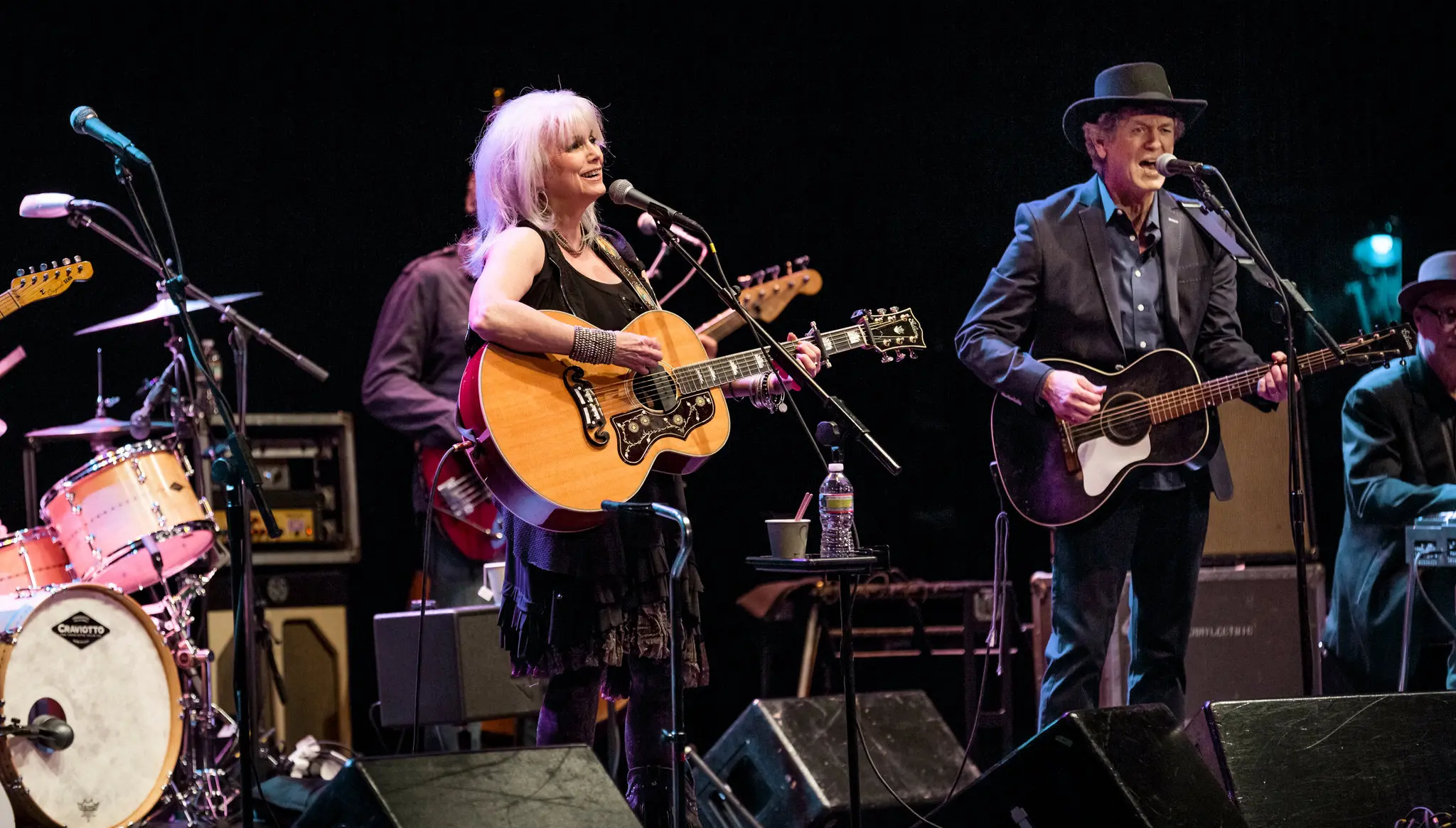
“Love Hurts” in Emmylou Harris’s world is not just a song about heartbreak—it is heartbreak made beautiful, the kind that lingers after the tears are gone and turns sorrow itself into memory, devotion, and myth.
One of the most important facts to place right at the beginning is that “Love Hurts” was not originally an Emmylou Harris solo hit single, but a song deeply tied to her artistic bond with Gram Parsons. Written by Boudleaux Bryant, the song was first recorded by the Everly Brothers in 1960, then later became famous through several later versions, especially Nazareth’s worldwide hit in the mid-1970s. But for Emmylou Harris, the most meaningful version was the duet she sang with Gram Parsons on his posthumously released 1974 album Grievous Angel. That recording gave the song a permanent place in her emotional history. It was never a charting Emmylou solo single in the ordinary commercial sense, yet it became one of the defining performances associated with her early career and with the brief, fateful partnership that changed her life.
That distinction matters, because “Love Hurts” in the hands of Emmylou Harris is not merely a cover of an old standard. It is part of a much larger story—one of artistic awakening, loss, and devotion. When Harris met Gram Parsons, she was still finding her way, still closer to folk than to the country music that would eventually become her home. Parsons, with all his brilliance and damage, opened a door for her. He did not simply give her songs. He gave her a musical world. And so when the two of them sang “Love Hurts”, the performance carried a truth larger than technique. It sounded like two souls meeting inside a song that already knew too much about pain.
The meaning of the song is plain enough on the surface. “Love Hurts” is one of the simplest titles ever written, and one of the most durable. It does not argue. It does not decorate. It states. Love hurts. That is the whole old tragedy of the heart reduced to three blunt words. Yet what gives the song its lasting force is that it does not sound cynical when sung properly. It sounds wounded. There is a difference. Cynicism closes the heart; this song sings from a heart already marked, but still capable of feeling. That is why it has survived so many versions. The truth it tells is too old, too human, and too immediate to wear out.
What makes Emmylou Harris’s connection to the song so unforgettable is the way she sings pain without ever coarsening it. Her voice has always had that strange and beautiful quality of making sorrow sound almost illuminated. On “Love Hurts,” she does not force the emotion. She lets it arrive quietly, with grace, as if the hurt has already settled deep enough that it no longer needs to cry out. That is often the saddest kind of heartbreak—the heartbreak that has passed beyond shock into knowledge. Harris understood that instinctively. She never treated grief as theater. She treated it as weather.
And because of Gram Parsons, the song carries even more weight in her story. After his death in 1973, Harris did not leave “Love Hurts” behind as just another duet from an unfinished chapter. She continued to sing it across the years, keeping it alive in performance and in memory. That matters more than chart numbers ever could. Some songs belong to the marketplace. Others belong to the soul of an artist. “Love Hurts” belongs to the second category for Emmylou. It became part of the emotional inheritance she carried forward from Parsons into her own long, extraordinary career.
There is also something especially moving in the contrast between the song’s simple language and the depth of feeling it opens. So many great heartbreak songs try to impress us with clever lines or elaborate scenes. “Love Hurts” needs none of that. It is almost severe in its directness. That directness was always one of Harris’s great strengths as an interpreter. She knew that the plainest words often cut deepest when sung by someone who believes them. In her voice, the song becomes not a complaint, but a reckoning. It stands there, steady and sorrowful, and lets the listener recognize something painfully familiar.
So “Love Hurts” deserves to be heard as one of the most important emotional threads in Emmylou Harris’s musical life: a Boudleaux Bryant song first recorded by the Everly Brothers, immortalized in one way by Nazareth, but given a wholly different kind of immortality through Emmylou Harris and Gram Parsons on Grievous Angel. But beyond release history and version history lies the real reason the song endures. In Emmylou’s voice, “Love Hurts” becomes more than a statement of pain. It becomes an act of remembrance. A wound kept tender by music. A truth too simple to escape. And a song that still, after all these years, sounds like it knows exactly what the heart has paid.
