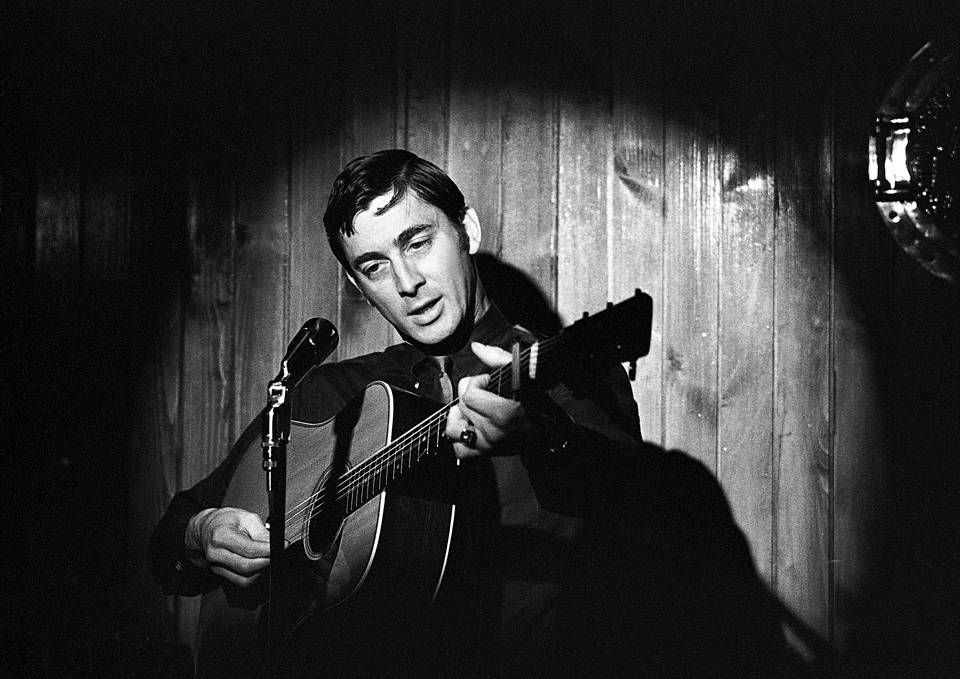
A Southwestern café scene became one of Canadian country’s clearest portraits of distance, memory, and the working West.
In 1987, Ian Tyson released Navajo Rug as a single from Cowboyography, the album that brought his modern cowboy-song writing into sharp public focus. The recording does not announce itself like a national statement. Its geography seems to belong first to roadhouses, desert highways, and a remembered room somewhere far from home. Yet that is part of why its Canadian country legacy has lasted: Tyson made the West feel less like a border-defined place than a state of memory, work, weather, and longing.
Navajo Rug, co-written by Ian Tyson and Tom Russell, is built around a compact scene. There is a roadside meal, a café atmosphere, a woman named Katie, and the title object fixed in the singer’s mind. The song moves with the economy of a good short story. It does not explain too much. It lets a few details carry the emotional weight, then returns to them until they feel less like decoration than evidence. The rug is not merely part of the setting; it becomes a marker of what memory saves when the rest of life keeps moving.
Tyson’s vocal performance gives the song its distinctive authority. He does not overplay the ache in the lyric. His phrasing is dry, steady, and conversational, as if the story has been told before but still has one place where it catches. That restraint is crucial. A more theatrical singer might have turned the memory into melodrama. Tyson lets it remain weathered and unresolved. He sounds close to the story without sounding trapped inside it, and that balance gives the recording much of its quiet force.
The arrangement supports that same discipline. The track carries a modest country swing, enough motion to suggest travel but not enough polish to erase the dust from the scene. Guitars and rhythm hold the road underneath him, while the melody leaves room for the words to land plainly. Nothing in the recording feels inflated. Its strength comes from proportion: a memorable refrain, a clear narrative frame, and a performance that trusts understatement. In that sense, Navajo Rug belongs to the older ballad tradition while still sounding like a late twentieth-century country record.
The importance of Cowboyography in Canadian country rests partly on that balance between inheritance and renewal. Tyson was not beginning as an unknown figure; his earlier work with Ian & Sylvia had already placed him deep inside Canadian folk memory. But Cowboyography marked a different kind of artistic focus. Rather than treating cowboy music as a museum piece, Tyson wrote and sang it as a living language connected to ranch work, western landscapes, rodeo towns, border stories, and the emotional habits of people who learn to endure distance. Navajo Rug became one of the album’s most recognizable examples of that approach.
Its Canadian character is not obvious in a postcard sense. The song’s scene leans toward the American Southwest, and its imagery does not need a maple leaf to justify its place in Canadian country. What makes it Canadian in Tyson’s hands is the vantage point: a northern western singer looking across a larger continental range and finding emotional truth there. Canadian country has often had to negotiate vastness, isolation, imported influences, and local identity all at once. Navajo Rug answers that challenge not by narrowing the map, but by widening the idea of what a Canadian country song can hold.
The collaboration with Tom Russell also matters. Russell’s borderland storytelling and Tyson’s Alberta-rooted plainness meet in a song that feels both specific and open-ended. Katie is not heavily explained. The room is not overdescribed. The past is not solved. The listener is left with an image, a name, and a question that keeps circling back. That is why the song has remained useful to singers and listeners alike: it gives just enough to enter, and enough space to bring one’s own remembered places along.
As a 1987 single, Navajo Rug helped carry the reputation of Cowboyography beyond a specialized western audience. It showed that contemporary cowboy writing could be literate, melodic, and radio-friendly without smoothing away its particular grain. In the Canadian country conversation, that was no small achievement. Tyson’s recording suggested that rural and western songs did not have to chase trends to feel alive. They could rely on craft, landscape, character, and a voice that understood the value of leaving some feelings unspoken.
The lasting legacy of Navajo Rug is therefore not only its refrain or its vivid café memory. It is the permission it gave to hear Canadian country as spacious, border-crossing, and emotionally exact. Tyson found a way to sing the West without reducing it to scenery. He let a small remembered room stand for all the miles between who we were and what we can no longer find. A song can cross a border without losing its accent, and in Tyson’s hands, that crossing became part of the Canadian country inheritance.
