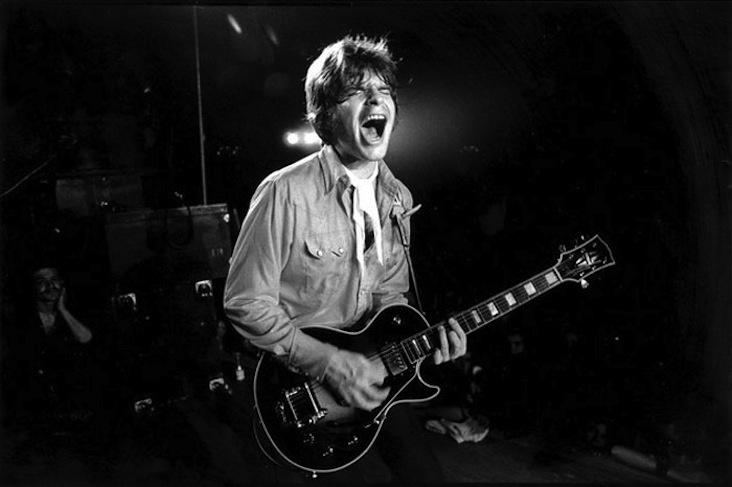
On You’re the Reason, John Fogerty turned a country favorite into a quiet test of whether he could carry a whole band by himself.
John Fogerty’s cover of Bobby Edwards’ You’re the Reason sits inside one of the most revealing transitions of his career: the 1973 solo debut The Blue Ridge Rangers. The album arrived after Creedence Clearwater Revival had broken apart, but it did not present Fogerty as a conventional solo star stepping into the spotlight under his own name. Instead, it was released under a group identity, even though Fogerty arranged the material, sang, and played all the instruments himself. That contradiction gives the recording its unusual emotional weight. It sounds communal, almost porch-lit, yet it was built by one man alone.
The Blue Ridge Rangers was not an album of new Fogerty originals. It was a carefully chosen collection of country, gospel, and early rock-rooted songs, a move that might have seemed modest from the man whose voice had powered Bad Moon Rising, Fortunate Son, and Proud Mary. But the modesty was part of the statement. Rather than answer the end of Creedence with a grand declaration, Fogerty reached backward into the music that had shaped him. He chose songs that already had lives of their own and then rebuilt them with his hands, instrument by instrument.
You’re the Reason had first found broad attention through Bobby Edwards in the early 1960s, crossing the border between country directness and pop accessibility. It is not a song that hides behind elaborate imagery. Its power is in its plain speech: a singer identifying the source of longing, confusion, and emotional dependence with almost no ornament. That kind of lyric can be unforgiving. If the singer overplays it, the feeling becomes theatrical. If the arrangement gets too clever, the simplicity is lost. Fogerty’s version understands the shape of the song and respects its open spaces.
What makes this recording especially striking is the knowledge that the band sound is an illusion. The name The Blue Ridge Rangers suggests a group gathered around shared instincts, perhaps trading glances across a studio floor. In reality, Fogerty was layering himself into that imagined room. The drums, the guitars, the rhythm, the vocal presence, the arrangement choices all came from the same musical mind. For an artist emerging from one of American rock’s most recognizable bands, that was more than a technical feat. It was a way of proving continuity without pretending nothing had changed.
Fogerty had always carried country, blues, rockabilly, gospel, and swampy American mythology into Creedence’s sound, even when the band was at its most urgent. On You’re the Reason, he removes much of the thunder and lets the roots show more plainly. The vocal is familiar in grain, but it sits in a different posture. There is less of the clenched public alarm that marked some of his Creedence performances and more of a craftsman’s restraint. He does not need to dominate the song. He steadies it. He lets the melody lean forward without pushing it into spectacle.
That restraint matters because The Blue Ridge Rangers arrived at a delicate moment. Creedence Clearwater Revival had officially ended in 1972, closing a run that had been remarkably intense and culturally visible. Fogerty’s voice was inseparable from that history, but this 1973 debut did not simply try to extend the Creedence formula under another banner. By choosing covers, he placed himself in conversation with tradition rather than immediately competing with his own past. By playing everything himself, he also accepted a different kind of exposure. There was nowhere to hide inside the arrangement. Every part reflected his taste, discipline, and sense of timing.
Heard that way, You’re the Reason becomes more than a respectful country cover. It becomes a small portrait of a musician in between chapters. The song’s emotional language is romantic, but the performance carries a career resonance of its own. The phrase itself seems to echo beyond the lyric. What is the reason to keep going after a famous band collapses? What is the reason to return to old songs when everyone may be waiting for a new anthem? Fogerty does not answer those questions directly. He answers by playing, arranging, stacking sound on sound until the imagined Rangers come alive.
There is something quietly bold about that choice. Many artists respond to reinvention by changing costume, chasing fashion, or announcing a clean break. Fogerty’s move was stranger and more inward: he created a band name, filled every chair himself, and sang other people’s songs as if tracing a map back to first principles. Bobby Edwards’ You’re the Reason gave him a melody simple enough to reveal the architecture of that decision. Nothing about it needed to be inflated. Its strength was in the way it allowed Fogerty to sound both familiar and newly solitary.
Decades later, the track still carries that double image. It is warm enough to feel like a band record and exact enough to remind you that it was assembled by one person with a very clear ear. It does not ask to be ranked against the biggest Creedence songs, and it does not need to be. Its importance lies elsewhere, in the quiet aftermath, when a famous voice stepped away from the group that defined him and tested whether the music inside him could still gather itself into a room. On You’re the Reason, John Fogerty did not merely cover Bobby Edwards. He built a bridge from collapse to continuation, one instrument at a time.
