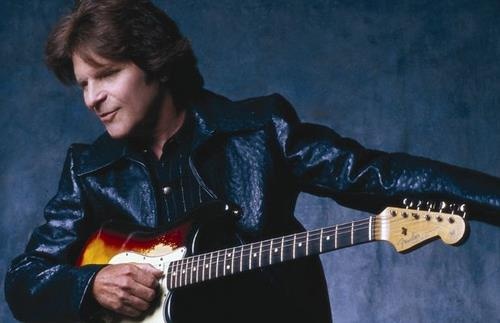
On Radar, John Fogerty briefly steps away from the weathered road and lets a sleeker, stranger rhythm reveal how restless his studio instincts could be.
Radar appears on John Fogerty’s 2004 album Déjà Vu All Over Again, a record often remembered through the gravity of its title track and its sense of history circling back. Released seven years after the Grammy-winning Blue Moon Swamp and three years before Revival, the album arrived at a point when Fogerty was no longer trying to prove that the old fire was still there. It was there. What made Radar unusual was something else: it showed him treating the studio not only as a place to restate his roots, but as a room where an unexpected groove could pull the floor out from under expectations.
For many listeners, Fogerty’s name summons a very particular physical world: the tight crack of a snare, the bite of a guitar, the forward push of a voice that never wasted a syllable. With Creedence Clearwater Revival and across much of his solo work, he built songs that felt hand-tooled, stripped to the strongest part, made for radio but also made for motion. Radar catches attention because it does not simply travel that road. It leans into a sleeker pulse, with a rhythmic discipline that brushes against disco and a clipped, slightly angular feel associated with new wave. The result is not a costume change so much as a rare glimpse of Fogerty letting modern textures press against his familiar instincts.
That matters because Fogerty’s best-known music is often discussed as if it appeared outside fashion. The swampy nickname, the roadside imagery, the American vernacular, the sharp little riffs that seem to have been carved rather than arranged: all of it can make his work feel almost elemental. But he was never merely an archivist. Centerfield, released in 1985, had already shown how thoroughly he could work alone in a contemporary studio environment, shaping a comeback with old rock-and-roll conviction and modern tools. Radar belongs to a different kind of experiment. It is smaller, less declarative, tucked into an album whose public conversation naturally gathered around the title song’s political ache. Yet precisely because it is not the obvious center of the record, it can feel like a loose wire sparking at the edge of the session.
The disco element in Radar is less about glitter than propulsion. Fogerty sounds interested in the way a steady beat can create pressure without the usual roots-rock swing. The new wave edge gives the track a sharper frame, as if the song is watching movement on a screen instead of looking down a dusty highway. That difference changes the emotional temperature. Where many Fogerty recordings hit like a band coming through a barroom door, Radar feels more mechanical, alert, and urban. Its title fits the atmosphere: scanning, detecting, tracking signals that may or may not become clear.
In the larger shape of Déjà Vu All Over Again, that texture is useful. The album carries the sense of an artist looking at cycles: political cycles, personal memory, musical inheritance, and the way old arguments return wearing new clothes. A song such as Radar turns that idea inward toward sound itself. It asks, quietly and without making a manifesto of it, what happens when a songwriter so strongly identified with guitar grit allows himself to be guided by a different kind of beat. The answer is not a full reinvention. It is more interesting than that. It is a flash of curiosity.
Fogerty’s voice is central to why the experiment holds together. Even when the arrangement points toward disco or new wave, the vocal does not become detached or mannered. It keeps the dry urgency that has always made his singing feel like a warning delivered in plain language. That tension gives Radar its character: one part sleek surface, one part stubborn human nerve. The track sounds like a man with a familiar instrument in his hands noticing that the room around him has changed, then deciding to play into that change rather than push it away.
By 2004, disco and new wave were no longer fashionable shocks. They were part of the long vocabulary of pop memory, sounds that had moved from the dance floor and the angular club stage into the wider language of recording. For Fogerty to touch those textures was not to chase a trend, but to test how far his own identity could bend before it stopped sounding like him. That is the appeal of Radar. It does not erase the songwriter behind it. It throws him into a different room and lets the walls answer back.
Because Radar was never the dominant public identity of the 2004 album, it can be easy to pass by. But studio detours often tell us something that the signature songs do not. They reveal where an artist was curious, where he allowed uncertainty, where a private impulse made it onto the record before it could be smoothed into expectation. For John Fogerty, whose catalog is so often praised for directness, Radar stands out as a compact reminder that directness does not have to mean sameness. Sometimes the most revealing track is the one that briefly changes the lighting in the room.
