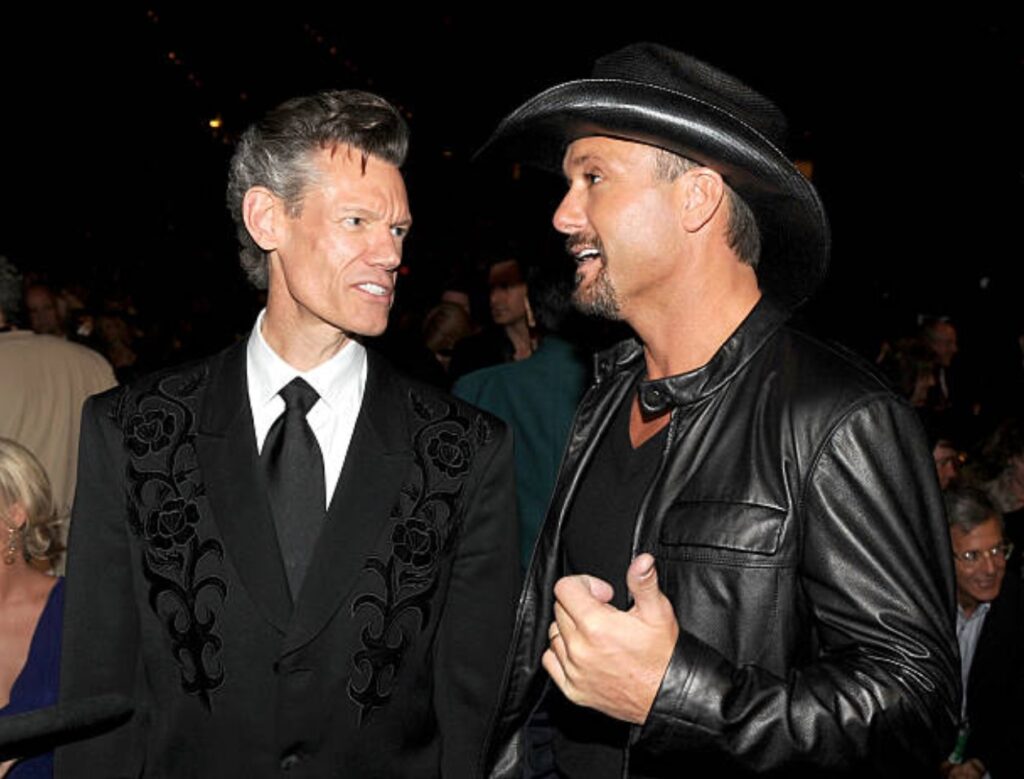
“Can’t Hurt a Man”: A Dialogue Between Two Generations and the Quiet Strength Beneath a Weathered Voice
In 2011, Randy Travis released Anniversary Celebration, an album built around collaborations with artists who either shaped him or were shaped by him. Among its standout tracks is “Can’t Hurt a Man”, a duet with Tim McGraw that reveals more than a simple exchange of verses. It is a conversation between two generations of country music and an exploration of what remains inside a man who has endured more pain than he ever admits.
“Can’t Hurt a Man” begins in a place of worn resilience. The lyrics portray a character who has lived through enough heartbreak that the world believes he can no longer feel anything. The song avoids dramatic confession. Instead, it approaches suffering quietly, allowing listeners to sense the weight beneath each line. This subtle emotional framing has long been a hallmark of Travis’s artistry, a style that treats pain not as spectacle but as something carried with dignity.
The presence of Tim McGraw adds dimension to the narrative. McGraw’s voice, smoother and more contemporary, contrasts with Travis’s unmistakable baritone. Where Travis conveys the gravity of experience, McGraw brings a gentler tone that suggests understanding rather than challenge. When they sing together, the effect is not merely harmonic blending but a symbolic passing of perspective. One voice reflects years of hardship, and the other reaches toward it with empathy. The duet becomes a dialogue between what has been lived and what has been learned from witnessing someone else’s struggles.
Musically, the arrangement remains understated. Acoustic lines guide the melody while soft rhythmic elements support the vocals without drawing attention away from them. This restraint allows the emotional core of the song to rise naturally. The production trusts the singers to carry the meaning rather than relying on embellishment. It is this minimalism that intensifies the message. When Travis delivers a line, the quiet around him makes every syllable feel deliberate. When McGraw answers, his voice settles beside Travis’s like someone joining an old friend on a long walk.
Within Travis’s discography, “Can’t Hurt a Man” holds a unique position. It does not showcase vocal power or dramatic storytelling. Instead, it reveals how Travis’s interpretive depth can turn a simple lyric into a portrait of human endurance. His ability to inhabit a character and make suffering feel both personal and universal is one of the reasons he shaped an entire generation of country singers. McGraw’s involvement reinforces this legacy. He stands as both collaborator and student, acknowledging the influence Travis had on his own musical path.
This song also underscores the cultural continuity within country music. Travis came to prominence as a champion of traditional sounds during an era of shifting trends. McGraw rose in a later generation that blended modern sensibilities with classic foundations. Their collaboration mirrors the genre’s ongoing evolution. It demonstrates that country music thrives not through constant reinvention but through artists sharing stories across eras. “Can’t Hurt a Man” embodies this exchange. It respects tradition while allowing contemporary voices to contribute new shades of feeling.
For listeners, the song invites reflection on the hidden chapters within every life. It suggests that strength is not the absence of hurt but the quiet endurance that follows it. Travis and McGraw convey this truth with sincerity that asks for no applause. Their duet is less about overcoming pain and more about acknowledging it with honesty. In doing so, they extend an unspoken hand to anyone who has ever felt worn down yet still moving forward.
“Can’t Hurt a Man” ultimately becomes a testament to the storytelling power that defines country music. It shows how two voices, shaped by different journeys, can meet in the center of a shared truth. Through this collaboration, Randy Travis and Tim McGraw give listeners not only a song but a moment of recognition, a reminder that even the strongest hearts carry stories no one else sees.
