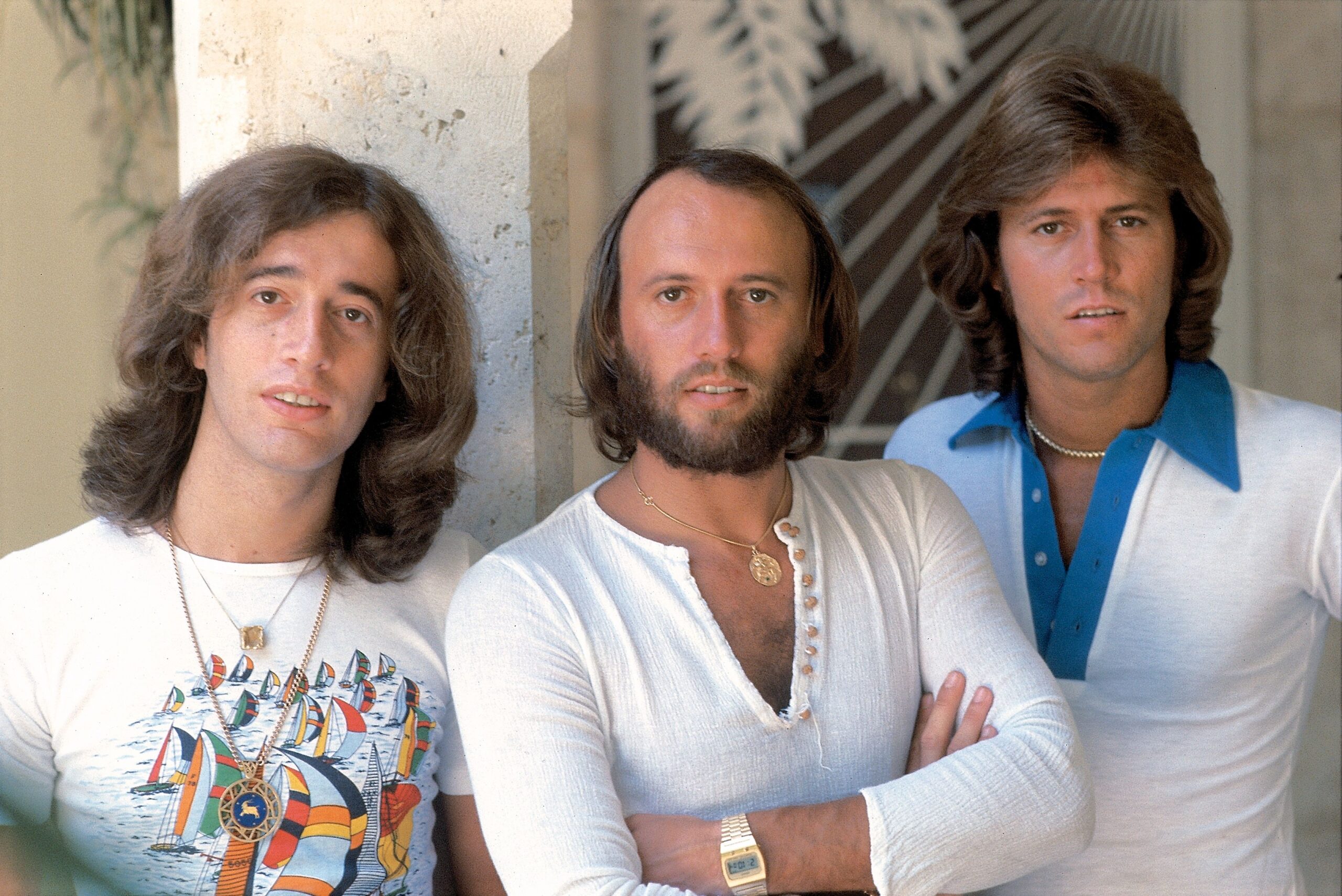
In Melbourne in 1989, The Bee Gees reached past the songs most people expected and uncovered an earlier, darker pulse in “I Can’t See Nobody”—a performance that reminded the room how deep their story had always been.
When The Bee Gees performed “I Can’t See Nobody” at the National Tennis Centre in Melbourne during the 1989 One for All Tour, they were not simply dusting off an old title from the vault. They were reintroducing a piece of their emotional foundation. The song had first appeared in 1967, in the same formative period that established the group as something far more complex than a hitmaking vocal act. Written by Barry Gibb and Robin Gibb, and associated with the era of Bee Gees’ 1st, “I Can’t See Nobody” carried the dramatic seriousness of the brothers’ early work: inward-looking, slightly shadowed, and full of the kind of tension that does not need volume to be felt.
That mattered in 1989, because by then the public image of The Bee Gees had been shaped by several different lifetimes. They were the ambitious young songwriters of the late 1960s, the architects of exquisitely arranged pop balladry, the voices behind some of the most recognizable recordings of the 1970s, and then, in the late 1980s, a group moving into a more reflective phase with the album One. On the One for All Tour, audiences could have been forgiven for expecting familiar anthems and polished crowd-pleasers. Instead, moments like “I Can’t See Nobody” opened a quieter door. They reminded listeners that before the world reduced the Bee Gees to any single era, there had always been an undercurrent of melancholy, mystery, and theatrical control in their music.
The Melbourne setting gave the performance another layer. Australia was not just another stop on the itinerary for the Gibb brothers. It was central to their early identity, the place where their first audience really formed and where their sense of themselves as performers took shape. To sing “I Can’t See Nobody” in Melbourne was to bring an early confession back into a landscape that had helped make it possible in the first place. Even inside a large venue, there was something almost intimate about that idea: a mature band standing before a modern concert crowd and returning to a song born from the restless imagination of their younger selves.
What makes “I Can’t See Nobody” so effective in live performance is that it resists easy prettiness. The song is built on emotional isolation, but it does not wallow. It moves with a measured sense of urgency, and its phrasing gives the singer room to sound both exposed and controlled at once. In the 1989 performance, that quality became even more striking. Arena production naturally broadened the sound, yet the song still held its original dramatic shape. The arrangement did not need to overpower the room. What mattered was the pressure inside the melody, the way the lines seemed to push forward and pull back at the same time, as if the song were trying to speak clearly while still protecting something private.
That is one reason the performance lingers. Live revivals of older material can sometimes feel ceremonial, as though the artist is acknowledging a chapter rather than re-entering it. This was different. The Bee Gees did not treat “I Can’t See Nobody” as a relic from their pre-fame mythology. They performed it as a living part of their vocabulary. The years had changed the texture of their voices and the balance of the stage, but those changes worked in the song’s favor. What had once sounded youthful and urgent now carried a more seasoned gravity. The emotional meaning had not disappeared; it had deepened.
There is also something revealing in the choice itself. A concert set tells the audience what an artist wants remembered, and sometimes what an artist feels still needs saying. By 1989, The Bee Gees had every reason to lean on the most universally recognizable chapters of their catalog. Bringing back “I Can’t See Nobody” suggested a different instinct. It pointed to continuity rather than reinvention, to the idea that the brothers’ career was not a series of disconnected masks but one long emotional line. The polished later years and the dramatic early years were not opposites after all. They were echoes of each other.
That is why the Melbourne performance still feels so rich. It was not built on spectacle alone, even in a large room. It worked because the song itself carried memory inside it. The audience heard not only a 1989 tour performance, but also the persistence of 1967: the ambition, the mood, the seriousness, the sense that pop music could be elegant and uneasy at the same time. In that sense, “I Can’t See Nobody” became more than a set-list surprise. It became a bridge between eras, a reminder that long careers are rarely held together by the biggest hits alone. Sometimes they are held together by the songs that kept the artist honest from the beginning.
And perhaps that is the quiet power of this performance at the National Tennis Centre. In a concert full of history, the Bee Gees chose not just to celebrate what the world already knew, but to return to a song that still asked something of them. The result was not nostalgia in the easy sense. It was recognition. Under the lights in Melbourne, “I Can’t See Nobody” sounded less like a memory than a truth that had simply waited for the right room to be heard again.
