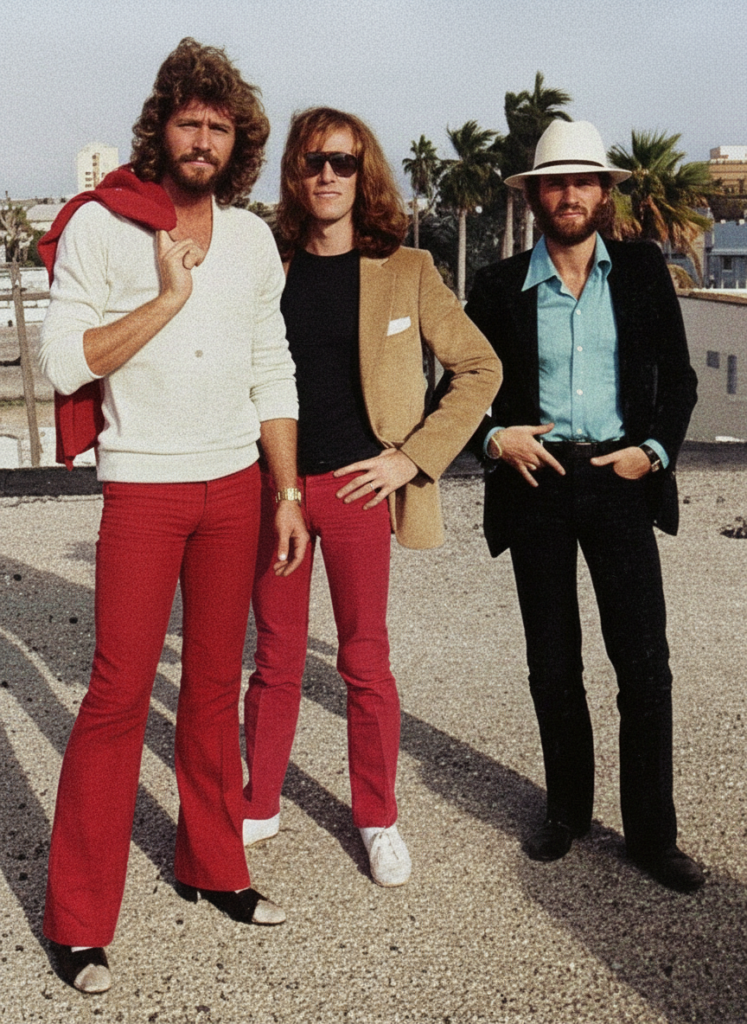
In 1973, the Bee Gees brought “To Love Somebody” to television not as a memory piece, but as a song still alive enough to change with them.
When the Bee Gees performed “To Love Somebody” live while hosting The Midnight Special in 1973, the moment carried more meaning than a simple return to an old favorite. The song had first appeared in 1967 on Bee Gees’ 1st, written by Barry Gibb and Robin Gibb during the group’s first great run, and it had already become one of the defining titles of their early catalog. But heard in 1973, on American television, it no longer sounded like a relic from a bright, ornate pop past. It sounded like three brothers standing in a complicated middle chapter, singing a song strong enough to survive the changes around them.
That is part of what makes this performance so compelling. By the early 1970s, the Bee Gees were in a transitional period. Their initial late-1960s ascent had made them one of the most recognizable vocal groups in popular music, with songs that mixed melancholy, melody, and a very distinct emotional delicacy. Yet the years that followed were less certain. There had been internal strain, a temporary split, reunion, and the difficult question that faces many gifted groups after early success: what do you sound like once the first version of yourselves has passed? In 1973, they had not yet arrived at the rhythm-heavy reinvention that would later reshape their career. They were still working their way toward it, and that uncertainty gives the performance its tension.
On The Midnight Special, a show that often captured artists in a more direct and immediate setting than formal variety television, the Bee Gees used “To Love Somebody” as more than a crowd-pleasing selection. The song itself had always contained more muscle than people sometimes remembered. Beneath its graceful melody and pleading lyric was a deeply soulful structure, one that invited singers to lean into ache rather than prettiness. In the studio version from 1967, that ache was already present, but it lived inside a carefully shaped pop recording. In the 1973 television performance, the edges feel more open. The brothers sound less ornamental, more grounded. The live setting lets the song breathe in a different way.
Barry Gibb’s lead vocal is central to that shift. In the late 1960s, his voice on the song carried youth, yearning, and a kind of polished desperation. By 1973, the tone had thickened slightly, and the phrasing feels more lived in. He does not merely revisit the line; he presses into it. The result is not louder emotion, but more adult emotion. The words land with a new kind of wear on them, as if time has altered not the meaning of the song, but the weight of its knowledge. Around him, Robin and Maurice Gibb help create the close, unmistakable Bee Gees blend, but in this performance the harmony feels less decorative than supportive, almost like the frame around a confession.
That live energy matters. Television performances from this era could sometimes flatten a song into presentation, but this one does the opposite. The stage environment, the band’s more present pulse, and the concentration of the brothers themselves give “To Love Somebody” a more physical body. What had once been heard mainly as a beautiful recording emerges here as a durable performance song, one that can withstand years, rearrangement, and a changed public image. There is something quietly moving about hearing artists sing one of their most beloved songs before the next major reinvention arrives. They are not yet the Bee Gees the world would soon know in another form, and precisely for that reason, the moment feels unguarded.
The 1973 context also sharpens the emotional reading of the song. Written in the late 1960s, “To Love Somebody” has long been admired for how directly it speaks. It is not complicated in its language, but its simplicity is deceptive. The lyric holds longing, frustration, devotion, and helplessness in almost equal measure. In the Midnight Special performance, that balance becomes more visible. The brothers do not treat the song as a fragile artifact from an earlier chapter. They sing it as if it still belongs to the present tense. That choice is important. It tells us something about the Bee Gees as interpreters of their own material: they understood that a strong song is not fixed at the moment of release. It can deepen as the singers deepen.
There is also a broader cultural pleasure in seeing the Bee Gees in this setting. For viewers, a television performance like this offered a chance to encounter them not through myth, chart memory, or later reputation, but in the active work of performance. The camera catches their concentration, their musical communication, and the way their identity as brothers remains inseparable from their sound. Even in a transitional period, that chemistry is unmistakable. They may have been between eras, but they were never between talents.
What lingers after watching this version is not just nostalgia for a famous song. It is the reminder that some recordings do not stay trapped in the decade that introduced them. “To Love Somebody” survived because it carried emotional truth, and the Bee Gees’ 1973 live reading proves how much truth was still left inside it. In that studio light, on that television stage, the song feels less like a return and more like a reckoning: a 1960s classic meeting a more weathered, soulful version of the men who made it.
